
Saturday, October 29, 2005
No Reason, but Hate
Kevin at The Command TOC posted one of his typically aggravating posts, railing on about the liar Bush, and distorting both recent history, and the arguments that undergird our liberation of Iraq, and our Global War on Terror more generally.
In response to a commenter Wildmonk who attempts to reason with him, Kevin resorts to the tired riposte, "Why Iraq? Why not Saudi Arabia?"
Every time somelike like Kevin makes this rebuttal argument, they underscore the point of "Why Iraq?"
In the geopolitical realities that faced the Bush Administration, the choices made have been entirely rational and logical. Attempts to derive ulterior motivations, while some may find them emotionally satisfying, reveal more about biases than actually realistically describe the likely points of decision since 9/11.
Immediately following 9/11, going after the Taliban in Afghanistan as the state sponsor and harborer of terrorist organizations, their leaders and training camps, was about as obvious and necessary a step as one could imagine. I don't know if Kevin was blogging then, I certainly wasn't nor reading any, but I was following many of the politicians and commentators often supported by those opposed to the war, who were entirely against our invasion of Afghanistan. Perhaps Kevin supported that, perhaps he didn't; but Bin Laden and such of his ilk were devastated by our assault, Bin Laden barely escaped, and has been on the run ever since, if he's even alive.
Subsequent to Afghanistan, the US still faced a very hostile world, despite the faux and short-lived sympathy for 9/11, and a world full of state sponsors of terrorism, both those of the institutional variety -- Libya, Sudan, North Korea, Iran, Iraq -- and ones more unofficially supportive, such as Saudi Arabia. Plus, many countries in Asia, the Middle East specifically, and Africa, knowingly tolerated radical Islamic terrorist organizations harbored in their midst (also including Iraq).
Attack them all at once? A recipe for disaster, surely, and those are disingenuous at best who even hint that they would have been supportive of anything remotely like it. Attack Saudi Arabia? Isn't that insane? Look at the hostile reaction to our effort in Iraq, and for most Arab states, Saddam was as much enemy as we were, no love lost there. Invade the home of Mecca and Medina? That would be a declaration of war against the entire muslim world.
Rather than inflame Muslims the world over, how about going after a select country or countries, who contribute to the overall terrorist effort, maybe are striving for nuclear weapons, mistrusted and hated within the region, a conduit for terrorist training, support, etc. How about making an example of a country that fits that description?
And oh by the way, how about finding a country that is in open violation of multiple UN Security Council Resolutions, which could be used as tipping points to either force cooperation (to thus neutralize the threat), or provide a justification for war, that a significant number of countries would be willing to join a coalition to conduct?
Not at all illogical, not a bit immoral. Practical, perhaps a bit cold blooded for some tastes, but how much less cold blooded than the heinous acts perpetrated against us (and aided, abetted, and cheered by such as the Palestinians and Saddam Hussein)?
The commenter Wildmonk has Kevin dead to rights. Bush "lied" only if everyone from the UN, NATO, European Leaders, all of Congress, Kerry, and of course Clinton lied as well. You've seen the quotes, I'm sure. About the menace posed by Saddam. The need to effect regime change.
There is no reasoning with such as he; for hatred is their only reason.
(NOTE: I might add, in an earlier post on a "censored MILBLOGGER," he also managed to slander Greyhawk and I, and suggest that our declarations that MILBLOGS are not being censored, nor shut down because they oppose our efforts in Iraq. Since the site he references is no longer online, I can't really comment specifically on his poster child for the censored MILBLOG. I would maintain skepticism, though, as the young man he highlights misstates several key facts about enlistment contracts and STOP LOSS policies. But that is another post, and another story.)
Links: Jo's Cafe, Wizbang, bRight & Early, Mudville Gazette
In response to a commenter Wildmonk who attempts to reason with him, Kevin resorts to the tired riposte, "Why Iraq? Why not Saudi Arabia?"
Every time somelike like Kevin makes this rebuttal argument, they underscore the point of "Why Iraq?"
In the geopolitical realities that faced the Bush Administration, the choices made have been entirely rational and logical. Attempts to derive ulterior motivations, while some may find them emotionally satisfying, reveal more about biases than actually realistically describe the likely points of decision since 9/11.
Immediately following 9/11, going after the Taliban in Afghanistan as the state sponsor and harborer of terrorist organizations, their leaders and training camps, was about as obvious and necessary a step as one could imagine. I don't know if Kevin was blogging then, I certainly wasn't nor reading any, but I was following many of the politicians and commentators often supported by those opposed to the war, who were entirely against our invasion of Afghanistan. Perhaps Kevin supported that, perhaps he didn't; but Bin Laden and such of his ilk were devastated by our assault, Bin Laden barely escaped, and has been on the run ever since, if he's even alive.
Subsequent to Afghanistan, the US still faced a very hostile world, despite the faux and short-lived sympathy for 9/11, and a world full of state sponsors of terrorism, both those of the institutional variety -- Libya, Sudan, North Korea, Iran, Iraq -- and ones more unofficially supportive, such as Saudi Arabia. Plus, many countries in Asia, the Middle East specifically, and Africa, knowingly tolerated radical Islamic terrorist organizations harbored in their midst (also including Iraq).
Attack them all at once? A recipe for disaster, surely, and those are disingenuous at best who even hint that they would have been supportive of anything remotely like it. Attack Saudi Arabia? Isn't that insane? Look at the hostile reaction to our effort in Iraq, and for most Arab states, Saddam was as much enemy as we were, no love lost there. Invade the home of Mecca and Medina? That would be a declaration of war against the entire muslim world.
Rather than inflame Muslims the world over, how about going after a select country or countries, who contribute to the overall terrorist effort, maybe are striving for nuclear weapons, mistrusted and hated within the region, a conduit for terrorist training, support, etc. How about making an example of a country that fits that description?
And oh by the way, how about finding a country that is in open violation of multiple UN Security Council Resolutions, which could be used as tipping points to either force cooperation (to thus neutralize the threat), or provide a justification for war, that a significant number of countries would be willing to join a coalition to conduct?
Not at all illogical, not a bit immoral. Practical, perhaps a bit cold blooded for some tastes, but how much less cold blooded than the heinous acts perpetrated against us (and aided, abetted, and cheered by such as the Palestinians and Saddam Hussein)?
The commenter Wildmonk has Kevin dead to rights. Bush "lied" only if everyone from the UN, NATO, European Leaders, all of Congress, Kerry, and of course Clinton lied as well. You've seen the quotes, I'm sure. About the menace posed by Saddam. The need to effect regime change.
There is no reasoning with such as he; for hatred is their only reason.
(NOTE: I might add, in an earlier post on a "censored MILBLOGGER," he also managed to slander Greyhawk and I, and suggest that our declarations that MILBLOGS are not being censored, nor shut down because they oppose our efforts in Iraq. Since the site he references is no longer online, I can't really comment specifically on his poster child for the censored MILBLOG. I would maintain skepticism, though, as the young man he highlights misstates several key facts about enlistment contracts and STOP LOSS policies. But that is another post, and another story.)
Links: Jo's Cafe, Wizbang, bRight & Early, Mudville Gazette


Flowers from the Graveyard of War
Joe Katzman writing at Winds of Change heralds "Chief Wiggles" book, Saving Babylon.
If you don't know who Paul "Chief Wiggles" Holton is, you need to go introduce yourself. Start with Joe's laudatory comments, then check out the Chief's website for the book, and buy it. They'll make great Christmas presents for anyone who wants to read an inspirational story about some of the best things that have come from our liberation of Iraq: the good works and sacrifices of the finest men and women to ever serve our country.
Here's an excerpt:
Links: Mudville Gazette
If you don't know who Paul "Chief Wiggles" Holton is, you need to go introduce yourself. Start with Joe's laudatory comments, then check out the Chief's website for the book, and buy it. They'll make great Christmas presents for anyone who wants to read an inspirational story about some of the best things that have come from our liberation of Iraq: the good works and sacrifices of the finest men and women to ever serve our country.
Here's an excerpt:
"Yes, war is hell; full of death, darkness, difficulties, and hard times. As soldiers we endure a lot and live without a lot, but all things can be turned into something positive as we look for ways to make a difference. Wherever we go, amidst death and destruction, there are opportunities to make a difference, to be a positive force for good. Small seemingly insignificant acts of love can bring about flowers from the graveyard of war."Chief Wiggles is a remarkable man, a remarkable soldier, a remarkable human being.
Links: Mudville Gazette
Friday, October 28, 2005
Light and Darkness (Part Two)
In looking up the Bible reference for Jesus’ teaching related to hiding “a light under a bushel, I discovered some variances on how this parable is presented in Matthew, Mark and Luke, whihc prompted me to investigate.
In Part One of this three part study, I discussed Matthew’s Gospel and the context within which the light under a bushel metaphor is presented. Now, in Part Two, I will likewise explore the context within which Light and Bushel imagery is presented in the Gospel of Mark.
Over at Gladmanly.
In Part One of this three part study, I discussed Matthew’s Gospel and the context within which the light under a bushel metaphor is presented. Now, in Part Two, I will likewise explore the context within which Light and Bushel imagery is presented in the Gospel of Mark.
Over at Gladmanly.
Thursday, October 27, 2005
Conclusion: Leaving Home
(This is the second of a multi-part series I introduced, entitled "Conclusion.")
I’m glad these are the last days here. I’m going to miss them, I think.
You can miss something to which you might wish you had never grown accustomed. You might hate it, but speak fondly of it. One of our NCOs had a habit of responding, whenever others complained, “It’s free, ain’t it. Then it’s all good. It’s all good.”
Short of a week ago, our group of soldiers, the ones who I served with most closely, moved from the building we had inhabited for the past nine months. In doing so, we had to pack, ship, mail or get rid of all manner of personal and comfort items that helped all of us feel not quite so far away from the America of our leisure days (to the exten some of us had those).
A lot of us were stubborn about giving up our comforts, habits, or familiars.
What makes a place a home? Familiarity, certainly. We knew every broken door, every busted faucet, the way in which the water would settle in the low spots, and we’d use the squeegee to get rid of the water, to cut down on the bugs.
(The Squeegee, I’m convinced, was invented by Iraqis so all they had to do to wash the silt off stuff was hose everything down and then squeegee the water until it evaporated, which doesn’t take long at 120 degrees Fahrenheit.)
We had our routines, where we’d get our first cup of coffee, the Sergeant of the Guard bringing back breakfast items after posting the details. The habits of the staff, the wares of the Iraqi workers. (Rolexes, $20, DVDs, $5, all made under the unacknowledged but no less official auspices of the People’s Republic of China in state run factories.).
People make a home, too. The Nut with his boxes and boxes of everything he owned under the sun – a frustrating tale he’d not want me to share. Sanford and his junkyard truck, and scrounging trips to the dump. The Islander who can’t ever seem to get out of bed, the fitness fanatic with the wobbly digestion, the Old Timer and his rants about the Old Days, KBR, or any other piece of conversational toothjam that got caught up in his craw. The LT and his watery gruel, the CO and his workouts, the three Staff Sergeants that got thrown out of their respective rooms by aggravated roommates, and then shared a room amid friendly wagers of who would come out of the experience alive. Little Top and the precision of his daily schedule, and ability to get along with Mess, Maintenance and Supply while executing the Company’s administrative requirements. Sunday Night NASCAR, with precision tracking of whose predictions came the closest to the actual finishes of the drivers. The ever popular Mess Sergeant with her stickers, and her colleague Older Than He Looks, with his trivia questions written on the to-go plates.
I had my own room, and I know I was lucky to have it. A lot of soldiers have tents, or containerized housing units (CHUs). We were in a building that apparently was a kitchen, with a lot of tiled walls, lots of drains, and otherwise pretty spare walls and decorative flourishes. Sounds plain, and it was, but it also was very easy to keep clean, and as a result, a darn sight more livable than m ost of our buildings. Plus, we had room for everybody to have more than the minimum space and some privacy (depending on rank, of course).
We made it home. It was over to one side of the FOB, so we had a couple of close calls, rockets, mortars nearby, but thank God, nobody got hurt. A vehicle born improvised explosive device (VBIED) went off a couple of hundred yards from us, which was loud and quite a shock, and surprisingly, we were subjected to a rough rain of car parts, but nothing more.
We were a considerable distance from Battalion HQ, which was another advantage that increased livability.
We made it a home, we bounced against the walls and each other until we settled, we connected, and got to the easy familiarity of a neighborhood. And now, that part, that place is all gone.
Our relinquishing of living and work areas is a small microcosm of the overall reduction in US presence, writ large across the Iraqi landscape. As units rotate home and consolidate to several large, key bases, smaller and politically significant FOBs like ours are being emptied and turned over to the Iraqis, either the Iraqi Army or Government.
We had some fine real estate here. I’ve described the palaces. We have a near-2,000 year old Christian Church that is perhaps one of the oldest such structure outside of the Holy Land proper, and due to its age in the history of the Christian Churches of the Gentiles, of potential New Testament significance (if not known to Saint Paul himself).
I was blessed beyond hope with readily accessible Internet (CAT5 to my room), and an Internet Café and Phone Center right next door. We were able to install an Armed Forces Network (AFN) decoder/transceiver, which allowed us American television programming, if somewhat limited compared to cable.
We ran over 100 convoys, we had a couple of close calls, we still have a couple to go, but God willing, we’ve had no accidents or injuries.
We are winding down our last days on the FOB, and the entire unit is now stuffed cozily into a single building with the exception of senior officers and warrant officers. We ran the Lord of the Rings, extended edition, the past several evenings. Our maintenance and mess and supply sections – who were the ones who moved, along with my CO and I – are trying to feel at home in a new temporary home, before they get us all out of here.
We were dropped akimbo into this Other Neighborhood. This one had been inhabited only by our Intel and Staff soldiers, a place that, though very dark and dreary to our eyes, with day and night shifts sleeping throughout the entire day, had been their home, like ours. And we disturbed it. (They say we scared the fish away, but we did get the ducks to come by. And the fish return, when we feed them.)
Now we all settle into a new configuration, and grasp for semblance of home on the way back home. It has its attractions. Movie night was nice, the sunrises and sunsets are radiant.
It’s a lakeside chalet. The soldiers have enjoyed cool mornings and pleasant evenings, watching the sun come ujp or go down alongside water. Brilliant colors, a steady quiet, as far away from anything unpleasant as things get here outside of sleep.
They feed fish, and ducks. They get a chance to chat up soldiers from other sections who we haven’t really seen during the deployment. They work through new neighbor issues, the usual smack talking, trading insults, but with lighter hearts and brighter eyes than I’ve seen since we started.
Even the Battalion Commander (BC) has been seen spending a relaxed hour sitting out on the patio, talking to his soldiers.
We all had missions. Some were dangerous, some were tedious and frustrating, some were desperately dull. Dull is good, we say, boring is good. Every single one was important. Every one of us is somehow different than we were when we started.
Not least among the many things we each of us bring back from our time in Iraq, we each now have at least one new home we’ve made, and lost, and I suspect we’ll reminisce about for as long as we all sit around and tell stories to our friends and family, about those 9 months we made Iraq our home.
Links: Jo's Cafe, bRight & Early, Mudville Gazette, Outside the Beltway
I’m glad these are the last days here. I’m going to miss them, I think.
You can miss something to which you might wish you had never grown accustomed. You might hate it, but speak fondly of it. One of our NCOs had a habit of responding, whenever others complained, “It’s free, ain’t it. Then it’s all good. It’s all good.”
Short of a week ago, our group of soldiers, the ones who I served with most closely, moved from the building we had inhabited for the past nine months. In doing so, we had to pack, ship, mail or get rid of all manner of personal and comfort items that helped all of us feel not quite so far away from the America of our leisure days (to the exten some of us had those).
A lot of us were stubborn about giving up our comforts, habits, or familiars.
What makes a place a home? Familiarity, certainly. We knew every broken door, every busted faucet, the way in which the water would settle in the low spots, and we’d use the squeegee to get rid of the water, to cut down on the bugs.
(The Squeegee, I’m convinced, was invented by Iraqis so all they had to do to wash the silt off stuff was hose everything down and then squeegee the water until it evaporated, which doesn’t take long at 120 degrees Fahrenheit.)
We had our routines, where we’d get our first cup of coffee, the Sergeant of the Guard bringing back breakfast items after posting the details. The habits of the staff, the wares of the Iraqi workers. (Rolexes, $20, DVDs, $5, all made under the unacknowledged but no less official auspices of the People’s Republic of China in state run factories.).
People make a home, too. The Nut with his boxes and boxes of everything he owned under the sun – a frustrating tale he’d not want me to share. Sanford and his junkyard truck, and scrounging trips to the dump. The Islander who can’t ever seem to get out of bed, the fitness fanatic with the wobbly digestion, the Old Timer and his rants about the Old Days, KBR, or any other piece of conversational toothjam that got caught up in his craw. The LT and his watery gruel, the CO and his workouts, the three Staff Sergeants that got thrown out of their respective rooms by aggravated roommates, and then shared a room amid friendly wagers of who would come out of the experience alive. Little Top and the precision of his daily schedule, and ability to get along with Mess, Maintenance and Supply while executing the Company’s administrative requirements. Sunday Night NASCAR, with precision tracking of whose predictions came the closest to the actual finishes of the drivers. The ever popular Mess Sergeant with her stickers, and her colleague Older Than He Looks, with his trivia questions written on the to-go plates.
I had my own room, and I know I was lucky to have it. A lot of soldiers have tents, or containerized housing units (CHUs). We were in a building that apparently was a kitchen, with a lot of tiled walls, lots of drains, and otherwise pretty spare walls and decorative flourishes. Sounds plain, and it was, but it also was very easy to keep clean, and as a result, a darn sight more livable than m ost of our buildings. Plus, we had room for everybody to have more than the minimum space and some privacy (depending on rank, of course).
We made it home. It was over to one side of the FOB, so we had a couple of close calls, rockets, mortars nearby, but thank God, nobody got hurt. A vehicle born improvised explosive device (VBIED) went off a couple of hundred yards from us, which was loud and quite a shock, and surprisingly, we were subjected to a rough rain of car parts, but nothing more.
We were a considerable distance from Battalion HQ, which was another advantage that increased livability.
We made it a home, we bounced against the walls and each other until we settled, we connected, and got to the easy familiarity of a neighborhood. And now, that part, that place is all gone.
Our relinquishing of living and work areas is a small microcosm of the overall reduction in US presence, writ large across the Iraqi landscape. As units rotate home and consolidate to several large, key bases, smaller and politically significant FOBs like ours are being emptied and turned over to the Iraqis, either the Iraqi Army or Government.
We had some fine real estate here. I’ve described the palaces. We have a near-2,000 year old Christian Church that is perhaps one of the oldest such structure outside of the Holy Land proper, and due to its age in the history of the Christian Churches of the Gentiles, of potential New Testament significance (if not known to Saint Paul himself).
I was blessed beyond hope with readily accessible Internet (CAT5 to my room), and an Internet Café and Phone Center right next door. We were able to install an Armed Forces Network (AFN) decoder/transceiver, which allowed us American television programming, if somewhat limited compared to cable.
We ran over 100 convoys, we had a couple of close calls, we still have a couple to go, but God willing, we’ve had no accidents or injuries.
We are winding down our last days on the FOB, and the entire unit is now stuffed cozily into a single building with the exception of senior officers and warrant officers. We ran the Lord of the Rings, extended edition, the past several evenings. Our maintenance and mess and supply sections – who were the ones who moved, along with my CO and I – are trying to feel at home in a new temporary home, before they get us all out of here.
We were dropped akimbo into this Other Neighborhood. This one had been inhabited only by our Intel and Staff soldiers, a place that, though very dark and dreary to our eyes, with day and night shifts sleeping throughout the entire day, had been their home, like ours. And we disturbed it. (They say we scared the fish away, but we did get the ducks to come by. And the fish return, when we feed them.)
Now we all settle into a new configuration, and grasp for semblance of home on the way back home. It has its attractions. Movie night was nice, the sunrises and sunsets are radiant.
It’s a lakeside chalet. The soldiers have enjoyed cool mornings and pleasant evenings, watching the sun come ujp or go down alongside water. Brilliant colors, a steady quiet, as far away from anything unpleasant as things get here outside of sleep.
They feed fish, and ducks. They get a chance to chat up soldiers from other sections who we haven’t really seen during the deployment. They work through new neighbor issues, the usual smack talking, trading insults, but with lighter hearts and brighter eyes than I’ve seen since we started.
Even the Battalion Commander (BC) has been seen spending a relaxed hour sitting out on the patio, talking to his soldiers.
We all had missions. Some were dangerous, some were tedious and frustrating, some were desperately dull. Dull is good, we say, boring is good. Every single one was important. Every one of us is somehow different than we were when we started.
Not least among the many things we each of us bring back from our time in Iraq, we each now have at least one new home we’ve made, and lost, and I suspect we’ll reminisce about for as long as we all sit around and tell stories to our friends and family, about those 9 months we made Iraq our home.
Links: Jo's Cafe, bRight & Early, Mudville Gazette, Outside the Beltway
Christian Carnival XCIII is Up!
Christian Carnival #93 is up over at White Ribbon Warriors.
The first part of my series on Light and Darkness is featured. Lots of fine and enlightening reading up at the Carnival, check it out!
The first part of my series on Light and Darkness is featured. Lots of fine and enlightening reading up at the Carnival, check it out!
Tuesday, October 25, 2005
Conclusion: The New War Correspondent
(This is the first of a multi-part series I introduced, entitled "Conclusion.")
In some ways, I'm a War Correspondent.
Not that that's what I set out to be, but that's in effect what role I've taken on, trying to communicate sense and sensibility from the middle of a combat zone. Now for near-real time combat action, readers will need to go elsewhere (Ma Deuce Gunner, Thunder6 at 365 and a Wake-up, Michael Yon). My work at Dadmanly is more in the manner of Features rather than news, and perhaps aggravatingly for those who oppose our efforts, Opinion/Editorial (OP/ED).
But a correspondent on this war in Iraq, all the same.
I haven't seen mention of it specifically, rather than by comparison, but I conclude that Military Bloggers (MILBLOGGERs) are a new breed of War Correspondent. Talk about embedded, these men and women are a part of the very armed forces that serve America's national interests in the Global War on Terror (GWOT).
Throughout modern history, War Correspondents have taken on most of the risks and hardships that are likewise endured by the men and women who are the subjects of their reporting. They have been those voices closest to the fight, often the only means that their fellow citizens back home can learn anything meaningful about wars, and the people called upon to fight them. They capture the spirit of the fighting man or woman. They convey purpose, they articulate a larger mission, in human terms, even if they must shy away from operational details.
Often they become as attached to their subjects as they often are dependent upon them for their safety. The War Correspondent embodies the First Amendment placed in harm's way. He or she serves our country as much as if they signed an enlistment contract, took on a weapon, and followed the order to war.
Where are the War Correspondents today? Outside of Michael Yon and perhaps a bare handful of others, mostly in the Green Zone in Baghdad, more often than not, posted to the Hotel Bar. (Is it folly or wisdom that now causes Al Qaeda to now target the media at their places of employment?
I can't say I blame those reporters who seek safe haven. I'd rather serve my time there, too, if that had to be my mission (\irony off).
Which brings me to my point. I moonlight as a War Correspondent, an Army Journalist as it were, in addition to my day job as a Headquarters and Headquarters Company (HHC) First Sergeant. My Commander, key leaders, and some interested soldiers know what I do, but for the most part, I remain anonymous even within my own unit. I serve alongside those I may write about, and I write incidentally in the course of my serving here. For me, I rarely mention specific events -- out of Operational Security (OPSEC) concerns and an avoidance of any facts that might help enemy battle damage assessments (BDA) -- but more often, impressions and reflections.
One of the Army's great experiments with OIF, is allowing MILBLOGGERS to operate without censor or command control, with only the lightest of directives and proactivity, given the potential risk involved. Sure, in recent months military commanders at higher levels are beginning to express concern, clarifications were issued, some Blogs voluntary closed up shop. (See my earlier reports here, here, and here.)
But for the most part, the military has every reason to view the MILBLOG phenomena as a qualified success, with an overwhelming net gain in Public Affairs and media relations. The vast majority of MILBLOGS effectively self regulate operational details, at least sufficient to greatly degrade any possible exploitation by enemy intelligence agents or services.
Likewise, the MILBLOGS speak almost in unanimity, supportive of our efforts in Afghanistan and Iraq, and the Global War on Terror more generally. Of even greater significance, MILBLOGS came on the scene precisely when the American public was most hungry for some good news about our military, wholly supportive of our troops, and at the point of lowest public regard for an obviously biased and sometimes hostile mainstream media (MSM).
They were the right forces, at the right time, for the right mission. I'm proud to have been a small part in that effort. And I'd like to suggest an idea to the military brass no doubt mulling over MILBLOGS, what to do with them, what to do about them, and whether their obvious value is worth the potential risk in losing control of the military "staying on point."
The Army has a program whereby NCOs and Officers are identified as potential Army Trainers. They are given a Basic Instructor Training Course (BITC, but the name and acronym may have changed since I went through the program). Once trained in instructional technique (course preparation and teaching), a soldier is awarded an "H" designator after their military occupational specialty (MOS) designator. That makes me a 96B5H and 98C5H, which indicates that I am an Army qualified instructor at the rank of Master Sergeant in the MOS fields 98C and 96B.
These designations, and the requirement for most Army schools that only H qualified instructors be allowed to teach, ensures a professionalized Instructor base for critical Army education, especially MOS job training, but also non-commissioned officer (NCO) education system (NCOES) professional development courses.
I have this thought, that one of the ways the military can help professionalize blogging is to offer any soldier who shows aptitude and is willing to abide by some straightforward guidelines, training in blogging, writing, journalism, and OPSEC. The training would.be made available, with a certification that then would provide some enhanced access to military sources and information. The military could allow "B" (for Blogger) designated soldiers, for instance, display a logo as military certified (for example, thnat they are who they allude to be, role and assignment wise), to have a feed from press releases, to be invited to military events and press conferences, mission permitting, and could be part of the overall Information Operations (IO) effort.
Now some bloggers would no doubt object to being that tightly linked to the military, or fear that would limit their ability to speak their mind. These are valid concerns, and those bloggers could remain unaffiliated and independent, as they are now. But others, who don't mind a bit being part of the military's public relations campaign, and eager to further credential themselves as military reporters, observers, etc., would provide a capability for the military to enhance their communications plan within the overall GWOT.
Now it may be that the military will eventually want to professionalize bloggers, and re-establish and expand long-dormant MOS positions like Army Journalist, and create formal positions at higher levels of command.
In the meantime, I can imagine a day, when a Division sized unit might have several dozen "B" qualified Bloggers, assisted by the military in getting their message out, and giving the citizens back home ready access to military voices. While they are in the combat zone, as they conduct their missions.
The new War Correspondent: an Army Skill Designator? I know it sounds crazy, but who knows? Maybe that's where all this is headed. Soldiers will communicate, and the technology is expanding and improving in quantum leaps, providing capabilities to the average Joe and Jane that would never have been imagined even a few short years ago.
And if the Army is smart, rather than try to stop the trend, might want to seriously consider buying in and taking maximum opportunity to the best media relations men and women the military has: the MILBLOGGER.
Links: Jo's Cafe, Outside the Beltway, BRight & Early, Mudville Gazette, Indepundit, Dawn Patrol at Mudville, Cao's Blog
In some ways, I'm a War Correspondent.
Not that that's what I set out to be, but that's in effect what role I've taken on, trying to communicate sense and sensibility from the middle of a combat zone. Now for near-real time combat action, readers will need to go elsewhere (Ma Deuce Gunner, Thunder6 at 365 and a Wake-up, Michael Yon). My work at Dadmanly is more in the manner of Features rather than news, and perhaps aggravatingly for those who oppose our efforts, Opinion/Editorial (OP/ED).
But a correspondent on this war in Iraq, all the same.
I haven't seen mention of it specifically, rather than by comparison, but I conclude that Military Bloggers (MILBLOGGERs) are a new breed of War Correspondent. Talk about embedded, these men and women are a part of the very armed forces that serve America's national interests in the Global War on Terror (GWOT).
Throughout modern history, War Correspondents have taken on most of the risks and hardships that are likewise endured by the men and women who are the subjects of their reporting. They have been those voices closest to the fight, often the only means that their fellow citizens back home can learn anything meaningful about wars, and the people called upon to fight them. They capture the spirit of the fighting man or woman. They convey purpose, they articulate a larger mission, in human terms, even if they must shy away from operational details.
Often they become as attached to their subjects as they often are dependent upon them for their safety. The War Correspondent embodies the First Amendment placed in harm's way. He or she serves our country as much as if they signed an enlistment contract, took on a weapon, and followed the order to war.
Where are the War Correspondents today? Outside of Michael Yon and perhaps a bare handful of others, mostly in the Green Zone in Baghdad, more often than not, posted to the Hotel Bar. (Is it folly or wisdom that now causes Al Qaeda to now target the media at their places of employment?
I can't say I blame those reporters who seek safe haven. I'd rather serve my time there, too, if that had to be my mission (\irony off).
Which brings me to my point. I moonlight as a War Correspondent, an Army Journalist as it were, in addition to my day job as a Headquarters and Headquarters Company (HHC) First Sergeant. My Commander, key leaders, and some interested soldiers know what I do, but for the most part, I remain anonymous even within my own unit. I serve alongside those I may write about, and I write incidentally in the course of my serving here. For me, I rarely mention specific events -- out of Operational Security (OPSEC) concerns and an avoidance of any facts that might help enemy battle damage assessments (BDA) -- but more often, impressions and reflections.
One of the Army's great experiments with OIF, is allowing MILBLOGGERS to operate without censor or command control, with only the lightest of directives and proactivity, given the potential risk involved. Sure, in recent months military commanders at higher levels are beginning to express concern, clarifications were issued, some Blogs voluntary closed up shop. (See my earlier reports here, here, and here.)
But for the most part, the military has every reason to view the MILBLOG phenomena as a qualified success, with an overwhelming net gain in Public Affairs and media relations. The vast majority of MILBLOGS effectively self regulate operational details, at least sufficient to greatly degrade any possible exploitation by enemy intelligence agents or services.
Likewise, the MILBLOGS speak almost in unanimity, supportive of our efforts in Afghanistan and Iraq, and the Global War on Terror more generally. Of even greater significance, MILBLOGS came on the scene precisely when the American public was most hungry for some good news about our military, wholly supportive of our troops, and at the point of lowest public regard for an obviously biased and sometimes hostile mainstream media (MSM).
They were the right forces, at the right time, for the right mission. I'm proud to have been a small part in that effort. And I'd like to suggest an idea to the military brass no doubt mulling over MILBLOGS, what to do with them, what to do about them, and whether their obvious value is worth the potential risk in losing control of the military "staying on point."
The Army has a program whereby NCOs and Officers are identified as potential Army Trainers. They are given a Basic Instructor Training Course (BITC, but the name and acronym may have changed since I went through the program). Once trained in instructional technique (course preparation and teaching), a soldier is awarded an "H" designator after their military occupational specialty (MOS) designator. That makes me a 96B5H and 98C5H, which indicates that I am an Army qualified instructor at the rank of Master Sergeant in the MOS fields 98C and 96B.
These designations, and the requirement for most Army schools that only H qualified instructors be allowed to teach, ensures a professionalized Instructor base for critical Army education, especially MOS job training, but also non-commissioned officer (NCO) education system (NCOES) professional development courses.
I have this thought, that one of the ways the military can help professionalize blogging is to offer any soldier who shows aptitude and is willing to abide by some straightforward guidelines, training in blogging, writing, journalism, and OPSEC. The training would.be made available, with a certification that then would provide some enhanced access to military sources and information. The military could allow "B" (for Blogger) designated soldiers, for instance, display a logo as military certified (for example, thnat they are who they allude to be, role and assignment wise), to have a feed from press releases, to be invited to military events and press conferences, mission permitting, and could be part of the overall Information Operations (IO) effort.
Now some bloggers would no doubt object to being that tightly linked to the military, or fear that would limit their ability to speak their mind. These are valid concerns, and those bloggers could remain unaffiliated and independent, as they are now. But others, who don't mind a bit being part of the military's public relations campaign, and eager to further credential themselves as military reporters, observers, etc., would provide a capability for the military to enhance their communications plan within the overall GWOT.
Now it may be that the military will eventually want to professionalize bloggers, and re-establish and expand long-dormant MOS positions like Army Journalist, and create formal positions at higher levels of command.
In the meantime, I can imagine a day, when a Division sized unit might have several dozen "B" qualified Bloggers, assisted by the military in getting their message out, and giving the citizens back home ready access to military voices. While they are in the combat zone, as they conduct their missions.
The new War Correspondent: an Army Skill Designator? I know it sounds crazy, but who knows? Maybe that's where all this is headed. Soldiers will communicate, and the technology is expanding and improving in quantum leaps, providing capabilities to the average Joe and Jane that would never have been imagined even a few short years ago.
And if the Army is smart, rather than try to stop the trend, might want to seriously consider buying in and taking maximum opportunity to the best media relations men and women the military has: the MILBLOGGER.
Links: Jo's Cafe, Outside the Beltway, BRight & Early, Mudville Gazette, Indepundit, Dawn Patrol at Mudville, Cao's Blog
Conclusion
I am no doubt down to the last few of any communiqués I will generate as a soldier serving in a combat zone for Operation Iraqi Freedom (OIF) III.
I try to craft a rhetorical conclusion, a packaging of themes that sums up my time here, our time here, military web logging (blogging), or the entire mobilization experience.
Like some fractal image, as I zoom in and examine the complexity of the picture, I see the same complexity in microcosm that’s visible from afar. It’s just too complex an experience: the 18 month period of a mobilized Guardsman deployed with OIF III as part of our broader Global War on Terror; the insemination of the seeds of democracy in Iraq; the brave persistence of the Iraqi people; the emergence of Iraqi political will and leadership; purple fingers; the Land of Mesopotamia; the Modern Army; the American people, who shower their soldiers with love, prayers, and encouragement; and the families of our sailors, soldiers and airmen and women in the field, air, and ocean.
And the movement of God in me, our men and women, and those who lead us in this effort.
There’s too much to tell, the story suffers as I try to squeeze it into the demands of a (readable) blog post. So I’ll take it on, in pieces and in part, and trust my readers will forgive any discontinuity or occasional incoherence. (Ah, the value of an editor.)
Over the next several days (and perhaps weeks), I will try to take on a few major categories of experience to conclude my time in theater. Each of these will be identified with the word, “Conclusion,” but I am powerfully convicted that this is much more about things beginning, than anything ending, any time soon.
UPDATE: Posts in the Series:
The New War Correspondent
Leaving Home
Links: Indepundit
I try to craft a rhetorical conclusion, a packaging of themes that sums up my time here, our time here, military web logging (blogging), or the entire mobilization experience.
Like some fractal image, as I zoom in and examine the complexity of the picture, I see the same complexity in microcosm that’s visible from afar. It’s just too complex an experience: the 18 month period of a mobilized Guardsman deployed with OIF III as part of our broader Global War on Terror; the insemination of the seeds of democracy in Iraq; the brave persistence of the Iraqi people; the emergence of Iraqi political will and leadership; purple fingers; the Land of Mesopotamia; the Modern Army; the American people, who shower their soldiers with love, prayers, and encouragement; and the families of our sailors, soldiers and airmen and women in the field, air, and ocean.
And the movement of God in me, our men and women, and those who lead us in this effort.
There’s too much to tell, the story suffers as I try to squeeze it into the demands of a (readable) blog post. So I’ll take it on, in pieces and in part, and trust my readers will forgive any discontinuity or occasional incoherence. (Ah, the value of an editor.)
Over the next several days (and perhaps weeks), I will try to take on a few major categories of experience to conclude my time in theater. Each of these will be identified with the word, “Conclusion,” but I am powerfully convicted that this is much more about things beginning, than anything ending, any time soon.
UPDATE: Posts in the Series:
The New War Correspondent
Leaving Home
Links: Indepundit
Sunday, October 23, 2005
An Unshattered Spirit
Jim Hoft at Gateway Pundit has an excellent summary of Secretary Condi Rice’s visit to Alabama, a highlight of which was her speech, "The Tide of Democracy is Rolling," part of the Frank A. Nix Lecture Series at the University of Alabama, on Friday, October 21, 2005.
As Hoft describes it, Secretary Rice made a direct connection between the democracy movement spreading through the world, and her own experiences relating to the Civil Rights movement:
What does occur to me, that does seem completely in keeping with the character of our Madam Secretary, is that she was not to be denied her dream, not by the Ku Klux Klan, not by the racists such as Senator Byrd, not by the common obstacles of anyone who strives towards the pinnacle of her profession.
How in contrast to what passes for liberal ethic today, as malpracticed by so many in the Democratic Old Guard. Condoleeza Rice did not let race stand in her way, and the real and lingering difficulties posed for African Americans in the ‘60s and ‘70s, as she progressed in a stellar career in International Relations and Academia. Condoleeza Rice did not let any glass ceiling or the persistent barriers to women in Diplomatic and Foreign Policy spheres limit her accomplishments.
She serves a Republican administration, pursuing a progressive, assertive, historic foreign policy. She is caricatured in cartoons variously as a Plantation Mammy, as a Minstrel performer, or other hateful stereotypes. She is eloquent in the cause of Democracy, she is loyal and dedicated and articulate.
The political enemies of this administration are as wary of attacking her as they are reluctant to be direct in their opposition to the war in Iraq or the Global War on Terror. She’ll be a formidable adversary, but they don’t quite know how to deal with her.
The American people may be growing tired of the War in Iraq, but they’ll grow a lot more satisfied with the result as history in time proves the rightness of the purpose. Democrats have a quandary on their hands. If they attack the war effort directly, they look unpatriotic (and often are, in the manner of personal attack and insults to our armed forces). If they go after the rising stars such as Secretary Rice, they diminish in the eyes of people who may not agree with policy but like and trust those who implement it. (Consider this the current version of the Colin Powell effect.)
She continues to shine. She continues to articulate a bold and progressive view, full of the power of our ideals, rooted in the finest of our aspirations and the richness of our legacy, all of it, the bad along with the good. Because America overcomes our obstacles. We make amends for our mistakes. And yes, we rise above our tragedies and become better than we would have been, without stumbling.
There was a time in Birmingham, Alabama, when a young girl might have trembled in fear, and resign herself to the limitations of hate and bigotry. Much like a young woman in Iraq, she might have stayed in that place of hopelessness. But she took that chance, she saw the possibility, she took hold of the hope of a Nation awakening to the evils of separate but unequal.
And we all are the better for her effort, today.
Condoleeza Rice in ’08. Whether she wins or loses, whether she even wants it, she’s a woman of character and substance, and representative of the best of America. The opponents of the Administration she serves should take note.
Hat tip: Powerline
Links: Cao's Blog, Jo's Cafe, Wizbang, Indepundit, Outside the Beltway, Dawn Patrol at Mudville Gazette
As Hoft describes it, Secretary Rice made a direct connection between the democracy movement spreading through the world, and her own experiences relating to the Civil Rights movement:
Condoleezza Rice gave another exceptional speech to the delight of her homestate audience as part of the Frank A. Nix Lecture Series at the University of Alabama http://www.ua.edu/webcast/. Condoleezza weaved into her speech the Civil Rights Movement of her childhood, the great democracy movement we are witnessing in the world today, and the desire of each human being no matter what country, race, sex OR religion to the choices and gifts of democracy.Hoft links to an account of Secretary Rice’s visit to Birmingham with British Foreign Secretary Jack Straw published by the NY Times, which also included this excerpt of her speech:
"It was meant to shatter our spirit," she said of the bombing. "It was meant to say that we shouldn't rise up. Just a few weeks after Dr. Martin Luther King http://topics.nytimes.com/top/reference/timestopics/people/k/martin_luther_jr_king/index.html?inline=nyt-per said, 'I have a dream,' it was meant to tell us that, no, we didn't have a dream, and that dream was going to be denied."The NY Times article in which this account appeared intended this as part of a quite noticeable spin. The Times account suggests that Secretary Rice has pushed an activist Democracy spreading agenda on a reluctant Bush White House. It further intimates that Secretary Rice has previously avoided speaking of her youth in the difficult days of racial strife and the struggle for Civil Rights. Just from my limited experience with Secretary Rice’s public communications, this strikes me as mischaracterized.
What does occur to me, that does seem completely in keeping with the character of our Madam Secretary, is that she was not to be denied her dream, not by the Ku Klux Klan, not by the racists such as Senator Byrd, not by the common obstacles of anyone who strives towards the pinnacle of her profession.
How in contrast to what passes for liberal ethic today, as malpracticed by so many in the Democratic Old Guard. Condoleeza Rice did not let race stand in her way, and the real and lingering difficulties posed for African Americans in the ‘60s and ‘70s, as she progressed in a stellar career in International Relations and Academia. Condoleeza Rice did not let any glass ceiling or the persistent barriers to women in Diplomatic and Foreign Policy spheres limit her accomplishments.
She serves a Republican administration, pursuing a progressive, assertive, historic foreign policy. She is caricatured in cartoons variously as a Plantation Mammy, as a Minstrel performer, or other hateful stereotypes. She is eloquent in the cause of Democracy, she is loyal and dedicated and articulate.
The political enemies of this administration are as wary of attacking her as they are reluctant to be direct in their opposition to the war in Iraq or the Global War on Terror. She’ll be a formidable adversary, but they don’t quite know how to deal with her.
The American people may be growing tired of the War in Iraq, but they’ll grow a lot more satisfied with the result as history in time proves the rightness of the purpose. Democrats have a quandary on their hands. If they attack the war effort directly, they look unpatriotic (and often are, in the manner of personal attack and insults to our armed forces). If they go after the rising stars such as Secretary Rice, they diminish in the eyes of people who may not agree with policy but like and trust those who implement it. (Consider this the current version of the Colin Powell effect.)
She continues to shine. She continues to articulate a bold and progressive view, full of the power of our ideals, rooted in the finest of our aspirations and the richness of our legacy, all of it, the bad along with the good. Because America overcomes our obstacles. We make amends for our mistakes. And yes, we rise above our tragedies and become better than we would have been, without stumbling.
There was a time in Birmingham, Alabama, when a young girl might have trembled in fear, and resign herself to the limitations of hate and bigotry. Much like a young woman in Iraq, she might have stayed in that place of hopelessness. But she took that chance, she saw the possibility, she took hold of the hope of a Nation awakening to the evils of separate but unequal.
And we all are the better for her effort, today.
Condoleeza Rice in ’08. Whether she wins or loses, whether she even wants it, she’s a woman of character and substance, and representative of the best of America. The opponents of the Administration she serves should take note.
Hat tip: Powerline
Links: Cao's Blog, Jo's Cafe, Wizbang, Indepundit, Outside the Beltway, Dawn Patrol at Mudville Gazette
I oppose the Miers nomination
I oppose the Miers nomination.
While I have strong confidence that Ms. Miers, based on what has been reported of her religious practice and faith, would cooperate in scaling back the dramatic and unconstitutional overreach that is Roe v. Wade, that is not a reason to support her nomination.
Even less of a reason would be to fill a "woman's seat" on the bench. This is an insult to women. This country has travelled beyond the need for a "quota system" for female accomplishment, and women take leading positions in the large majority of professions, based on their merit. There are women jurists with excellent legal and judicial experience, nominate one of them by all means.
Conservatives insult the many principled stands they've taken on originalist interpretation and against judicial activism, if they yield in supporting Miers merely because she will support decisions they seek. That is the fabled litmus test that Democrats seek to impose -- when Republicans are nominating jurists, that is -- and should be anathema to "right thinking" (as in correct thinking) observers.
Miers has a good legal background, but her accomplishments bear little relationship to the actual processes of jurisprudence. A fine judge, she might yet be, but perhaps this might be demonstrated by a lesser judicial appointment, say the US Federal Court or the US Court of Appeals? I really don't like the idea of on the job training for a Supreme Court Judge.
Links: Dawn Patrol at Mudville Gazette
While I have strong confidence that Ms. Miers, based on what has been reported of her religious practice and faith, would cooperate in scaling back the dramatic and unconstitutional overreach that is Roe v. Wade, that is not a reason to support her nomination.
Even less of a reason would be to fill a "woman's seat" on the bench. This is an insult to women. This country has travelled beyond the need for a "quota system" for female accomplishment, and women take leading positions in the large majority of professions, based on their merit. There are women jurists with excellent legal and judicial experience, nominate one of them by all means.
Conservatives insult the many principled stands they've taken on originalist interpretation and against judicial activism, if they yield in supporting Miers merely because she will support decisions they seek. That is the fabled litmus test that Democrats seek to impose -- when Republicans are nominating jurists, that is -- and should be anathema to "right thinking" (as in correct thinking) observers.
Miers has a good legal background, but her accomplishments bear little relationship to the actual processes of jurisprudence. A fine judge, she might yet be, but perhaps this might be demonstrated by a lesser judicial appointment, say the US Federal Court or the US Court of Appeals? I really don't like the idea of on the job training for a Supreme Court Judge.
Links: Dawn Patrol at Mudville Gazette
Friday, October 21, 2005
Light and Darkness (Part One)
I have a new study up over at Gladmanly, Light and Darkness (Part One).
In looking up the Bible reference for Jesus’ teaching related to hiding “a light under a bushel, I discovered some variances on how this parable is presented in Matthew, Mark and Luke.
The nuances of the three presentations suggest something very remarkable about what I believe Jesus taught in this example. What’s more, the adjacent passages in all three gospels demonstrate the difference in emphasis that each of these disciples may have attached to this teaching.
As the first of a three part study, I first examine and discuss Matthew’s Gospel and the context within which the light under a bushel metaphor is presented.
For more, see Light and Darkness over at Gladmanly.
In looking up the Bible reference for Jesus’ teaching related to hiding “a light under a bushel, I discovered some variances on how this parable is presented in Matthew, Mark and Luke.
The nuances of the three presentations suggest something very remarkable about what I believe Jesus taught in this example. What’s more, the adjacent passages in all three gospels demonstrate the difference in emphasis that each of these disciples may have attached to this teaching.
As the first of a three part study, I first examine and discuss Matthew’s Gospel and the context within which the light under a bushel metaphor is presented.
For more, see Light and Darkness over at Gladmanly.
Thursday, October 20, 2005
Christian Carnival is Up!
Christian Carnival is up at the World of Sven.
Check it out; lots of good things to read at the Carnival.
Check it out; lots of good things to read at the Carnival.
Wednesday, October 19, 2005
United and Incandescent
George F. Will appeared at a Hillsdale College National Leadership Seminar in Dallas, Texas, May 23, 2005. At the conference, he delivered a very fine speech on the necessity of a doctrine of preemption. Imprimis, the national speech digest of Hillsdale College, adapted Will’s speech for their September 2005 issue, which warrants wider attention.
Will’s posed the following thesis as his central theme:
Will quotes Trotsky, “You may not be interested in war, but war is interested in you,” and declares:
Will uses a highly relevant anecdote from World War II to acknowledge that our enemies of 9/11 greatly underestimated our will and resolve. Will describes the recollections of Admiral Yamamoto, who could help his country launch their temporarily successful Pearl Harbor attack, but foresaw that in doing so, they would awake a sleeping giant:
Any one of us may be a light unto others, a light for a darkened world, a light of hope, encouragement, or enlightenment. Many of our faith traditions, mine included, even urge faithful followers to be light, to spread knowledge or revelation or good news. That is a kind of light, and certainly the wattage will increase as people join together in shared purpose to shine that light.
But united and incandescent? That reveals a glimpse of something more powerful, something terrible to behold, and righteousness and vengeance. One candle can only dispel just so much darkness, or emit the smallest amount of heat. Two or three, somewhat more. I remember one of my buddies in Germany owned a Volkswagen like I had with no heat, and in the winter he swore 4 candles for 20 minutes was enough to defrost the car.
Will’s image emits so much more. A Nation full of candles, all burning in common purpose. What light we generate. What heat we create. We burned those incandescent fires in World War II, and we burned as bright, blinding light, in the days after 9/11.
In my faith community, our God reserves unto Himself that kind of vengeance. Yet, He chooses as He will to use His instruments to exact retribution. And that may well be our National resolve.
The flames of our common fire may abate. Discord grows, purposes diverge, and politics, as always, blurs lines that once were clear. Yet we persevere, and our military vanquishes foe after foe, and keeps the forces of chaos on the run. But dangers persist, and continue to disperse, if they do not grow. Our enemies, having no real hope and no vision outside of mayhem, proceed relentlessly.
And the well-intentioned on all political sides do well to seek some common ground, and find ways to prevent another tragedy like 9/11, or the apocalyptic visions that rightly many fear.
Will calls to mind J. Robert Oppenheimer’s famous warning that we would have to search every incoming package or container, as the only certain means to prevent the smuggling of a nuclear device into the US. This is even more evident today, with nuclear suitcases and the great dispersion of nuclear material. Which leads Will to conclude the following, advocating a Doctrine of Pre-emption:
Clearly, Will ascribes the Idealist pedigree to Neoconservatives (“Neocons”). In his argument (as a Realist), Will diminishes the Idealists by extending certain of their general ideas beyond reason. Because Idealists (full discloser, count me as one) believe that the values and principles of liberty and democracy are universal, that we therefore believe that “every person is at heart a Jeffersonian Democrat, that all the masses of the world are ready for democracy,”
This is an exaggeration, and one, of course that sets a straw man up for Will to demolish. And yet, many of these same Idealists would agree with his conclusion, “Iraq may not be close to constitutional democracy just yet.” Yes, much work remains to be done, the greatest burden of which falls upon the Iraqi people themselves. But another election turnout that exceeded expectations, amid much greater safety for election workers and voters, has gone a long way towards convincing the Iraqi people themselves that they can responsibly take up the reigns of power and representation, regardless of the outcome.
Will goes on to remark that from the earliest days of our Republic, through the Modern era and the dark days of Vietnam, America has fretted over whether discouragements or discord will break our national will.
“This has been a constant recurring anxiety in America,” Will remarks, and quotes Winston Churchill’s bracing comments to America in the days immediately following Pearl Harbor:
We may at times be forgetful, or complacent, like lazy inheritors of the great treasures of civilization. We may not always hold ourselves to the standards of our own ideals. We have problems and failings. But we always wake from our moral slumbers, and as we rise, with more often than not find new definitions for both the price and value of freedom. We need to know that our ideas are right, according to Will:
We must struggle today with the fact that the doctrine of preemption is necessary, and with the serious problems it entails. But what we must have overall is the confidence that our ideas are right.
We are not perfect. We will make mistakes, but like no other nation in the history of the world, we will do our best to right wrongs, to make amends, to satisfy old grievances, and harken to forgotten peoples the world over.
And when we are all in it together, we create quite a light. United and incandescent.
As Jesus said, as recorded by Matthew:
Links: Indepundit, Jo's Cafe
Will’s posed the following thesis as his central theme:
…Only ideas have large and lasting consequences. We are in a war of terror being waged by people who take ideas with lethal seriousness, and we had better take our own ideas seriously as well. (Emphasis mine.)This war uses bombs and bullets and rockets and mines, and even commercial transport fashioned as weapons, but make no mistake. This is millennial battle of ideas.
Will quotes Trotsky, “You may not be interested in war, but war is interested in you,” and declares:
And this is a war with a new kind of enemy – suicidal, and hence impossible to deter, melding modern science with a kind of religious primitivism. Furthermore, our enemy today has no return address in the way that previous adversaries, be it Nazi Germany or Stalin’s Russia, had return addresses.Where we could effectively deliver the 500 pounders, the 1000 pounders, the Bunker Busters that could put an end to them. If that were all that was required, if we were facing that kind of enemy, we would have dispatched with them quite some time ago. As a people, we have exhausted our patience with whatever perceived grievances are supposed to justify their inhumanity to man. That kind of patience was incinerated and ground to dust as fine as the remains of the victims of 9/11.
Will uses a highly relevant anecdote from World War II to acknowledge that our enemies of 9/11 greatly underestimated our will and resolve. Will describes the recollections of Admiral Yamamoto, who could help his country launch their temporarily successful Pearl Harbor attack, but foresaw that in doing so, they would awake a sleeping giant:
He knew that after Pearl Harbor, Japan would have an enraged, united, incandescent, continental superpower on its hands, and that Japan’s ultimate defeat would be implicit in its initial victory. Our current enemies will learn the same thing.Having heard it, I am now very attached to that image.
Any one of us may be a light unto others, a light for a darkened world, a light of hope, encouragement, or enlightenment. Many of our faith traditions, mine included, even urge faithful followers to be light, to spread knowledge or revelation or good news. That is a kind of light, and certainly the wattage will increase as people join together in shared purpose to shine that light.
But united and incandescent? That reveals a glimpse of something more powerful, something terrible to behold, and righteousness and vengeance. One candle can only dispel just so much darkness, or emit the smallest amount of heat. Two or three, somewhat more. I remember one of my buddies in Germany owned a Volkswagen like I had with no heat, and in the winter he swore 4 candles for 20 minutes was enough to defrost the car.
Will’s image emits so much more. A Nation full of candles, all burning in common purpose. What light we generate. What heat we create. We burned those incandescent fires in World War II, and we burned as bright, blinding light, in the days after 9/11.
In my faith community, our God reserves unto Himself that kind of vengeance. Yet, He chooses as He will to use His instruments to exact retribution. And that may well be our National resolve.
The flames of our common fire may abate. Discord grows, purposes diverge, and politics, as always, blurs lines that once were clear. Yet we persevere, and our military vanquishes foe after foe, and keeps the forces of chaos on the run. But dangers persist, and continue to disperse, if they do not grow. Our enemies, having no real hope and no vision outside of mayhem, proceed relentlessly.
And the well-intentioned on all political sides do well to seek some common ground, and find ways to prevent another tragedy like 9/11, or the apocalyptic visions that rightly many fear.
Will calls to mind J. Robert Oppenheimer’s famous warning that we would have to search every incoming package or container, as the only certain means to prevent the smuggling of a nuclear device into the US. This is even more evident today, with nuclear suitcases and the great dispersion of nuclear material. Which leads Will to conclude the following, advocating a Doctrine of Pre-emption:
You have to go get it. You have to disrupt terrorism at its sources.Will correctly observes that the meaningful policy debate today is taking place between conservatives and conservatives, with liberals and progressives carelessly abandoning any serious discussion in favor of social bromides and revisionist histories ala Moore:
The old isolationism of the 1920s and 1930s was a conservative isolationism, and it held that America should not go abroad into the world because America is too good for the world. The contemporary liberal brand of isolationism – the Michael Moore view of the world – is that America should not be deeply involved in the world because the world is too good for America. This is not a serious argument, even though seriously held.Thus we have conservatives arguing amongst themselves, with all others adjourned to the bar for refreshments during the break. Will identifies these as Realists and the Wilsonian Idealists, those with a “crusading zeal for the export of democracy.”
Clearly, Will ascribes the Idealist pedigree to Neoconservatives (“Neocons”). In his argument (as a Realist), Will diminishes the Idealists by extending certain of their general ideas beyond reason. Because Idealists (full discloser, count me as one) believe that the values and principles of liberty and democracy are universal, that we therefore believe that “every person is at heart a Jeffersonian Democrat, that all the masses of the world are ready for democracy,”
This is an exaggeration, and one, of course that sets a straw man up for Will to demolish. And yet, many of these same Idealists would agree with his conclusion, “Iraq may not be close to constitutional democracy just yet.” Yes, much work remains to be done, the greatest burden of which falls upon the Iraqi people themselves. But another election turnout that exceeded expectations, amid much greater safety for election workers and voters, has gone a long way towards convincing the Iraqi people themselves that they can responsibly take up the reigns of power and representation, regardless of the outcome.
Will goes on to remark that from the earliest days of our Republic, through the Modern era and the dark days of Vietnam, America has fretted over whether discouragements or discord will break our national will.
“This has been a constant recurring anxiety in America,” Will remarks, and quotes Winston Churchill’s bracing comments to America in the days immediately following Pearl Harbor:
“We have not journeyed all this way across the centuries, across the oceans, across the mountains, across the prairies, because we are made of sugar candy.”Will goes on to describe this people, these Americans, who surely are not sugar candy:
The kind of people we are is a people who rise to the challenge of the new kind of enemy we have today. Our enemy has ideas. They are vicious, bad, retrograde, medieval, intolerant, and suicidal ideas, but ideas nevertheless. And we oppose them with the great ideas of freedom and democracy, which America has defined better than anyone in the world.The American people are greatly enamored of the ideas of their foundation. And so they should be. The American Experiment has served as a beacon of freedom and hope for the entire world for over 200 years. We are a source of inspiration for many, and a place of dreams for more. When words fail, our example serves. We breathe free.
We may at times be forgetful, or complacent, like lazy inheritors of the great treasures of civilization. We may not always hold ourselves to the standards of our own ideals. We have problems and failings. But we always wake from our moral slumbers, and as we rise, with more often than not find new definitions for both the price and value of freedom. We need to know that our ideas are right, according to Will:
We must struggle today with the fact that the doctrine of preemption is necessary, and with the serious problems it entails. But what we must have overall is the confidence that our ideas are right.
We are not perfect. We will make mistakes, but like no other nation in the history of the world, we will do our best to right wrongs, to make amends, to satisfy old grievances, and harken to forgotten peoples the world over.
And when we are all in it together, we create quite a light. United and incandescent.
As Jesus said, as recorded by Matthew:
“Let your light so shine before men, that they may see your good works and glorify your Father in heaven.” (Matthew 5:16)
Links: Indepundit, Jo's Cafe
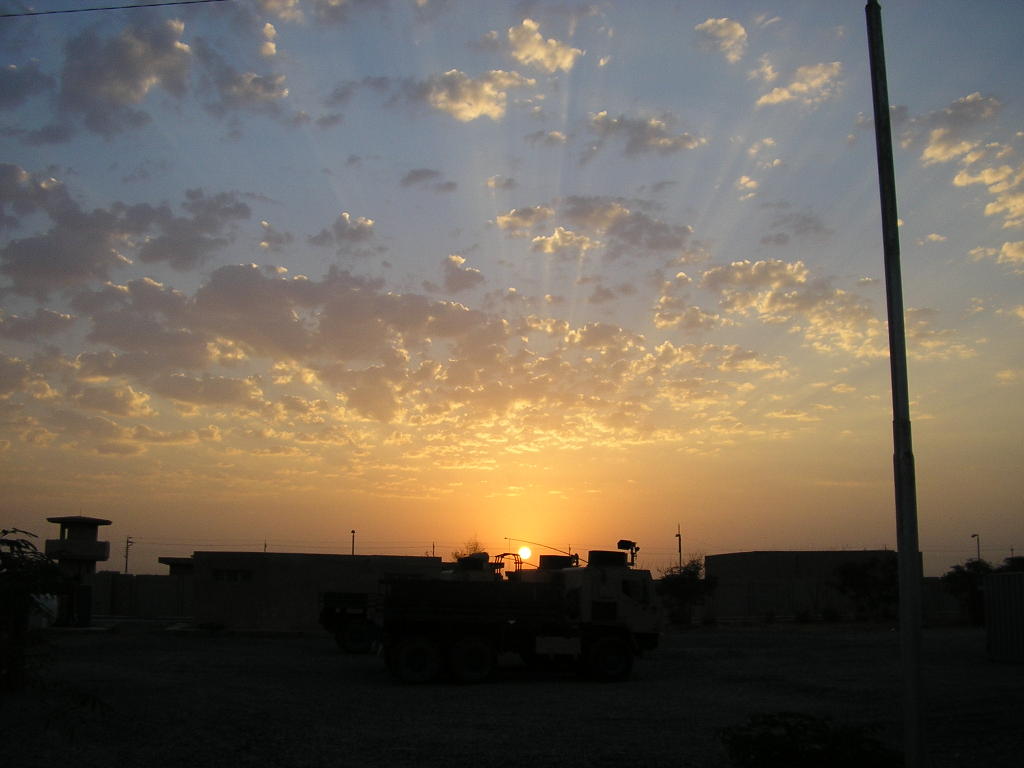
Clouds at Daybreak

Monday, October 17, 2005
Profile: The First Sergeant
“Easy does it, slow down now. Take it easy.” Rosie used to say that a lot, usually as a way to break up tension or get his soldiers to laugh. I think it had to do with the saying, “We start slow, and then taper off.”
He always had a joke, or something funny to share, a story or some thing he’s seen that somehow caught everybody off guard, funny, even if we’d heard it before.
I first met Rosie when my Mobile Training Team was teaching an Intelligence Military Occupational Specialty (MOS) course to some National Guard soldiers, whose Military Police (MP) unit had just been converted to a Military Intelligence (MI) unit. (We always joked that someone at State HQ must have thought they were half way there already, it’d be easy to teach them the “Intel” part.
The MPs in the class were all characters, but Rosie was the King of Clowns in this bunch. He used to pull all kinds of gags on his soldiers, and always had some trick to pull on someone taking themselves too seriously. One of our Classified training sites had a PA system, and he had us in stitches when he would make announcements, directing the unsuspecting to a room number that turned out to be a latrine.
When I met Rosie, I was pretty gullible – heck, ask the LT, I’m still pretty gullible – and every other month Rosie would get me all fired up over something that wasn’t true. He’d tell me some story about some crazy thing the unit or the officers were planning, then watch me get all lit up and chase down some rabbit hole, only to find it was another of Rosie’s stunts. I took myself too seriously then, maybe I still can, but Rosie helped me shave about 50% of that away for good.
Rosie always took care of his soldiers, every one. He may have covered for them a few too many times, he may have given some too many breaks when they needed to get straightened out, but he always tried to do his best for his guys. “Youse guys,” he would say. He was old school, but he had the biggest heart in the unit.
He had the biggest footlocker, too. Every time we went anywhere, even the first times we went away for two weeks Intel training, with billeting being a Hilton Hotel, Rosie would bring his box. Peanut Butter in great big Cafeteria size canisters. Toilet paper, crackers, coffee, sugar, toiletries.
I was new to the unit then, newly transferred to the Guard from the Reserves, and new to this strange new creature, the First Sergeant. I don’t even remember any previous First Sergeants, in Active Duty or the Reserves, except the Samoan First Sergeant at the Language School in Monterey. I remember him because we once had to go home on Emergency Leave when my brother-in-law passed away tragically at the age of 16. And all I remember of that 1SG, is that he was incredibly helpful in getting us out of town.
Rosie ran everything, but he did it with an easy manner, a twinkle in his eye, he charmed far more often than he bludgeoned, and he knew everybody and everybody knew him. He was like everybody’s Dad, watching out for and over them, making sure they didn’t drive if they drank too much, that we steered them clear of trouble before it happened, and we helped them however we could if they stumbled or needed some help. He set up and ran a little coffee and roll operation, making use of fresh baked hard rolls, gobs of butter and peanut butter of course. Those rolls and coffee were there every day of every drill as long as he was there.
Rosie kept the officers off our backs, what few of them there were who really wanted to climb up on top of them. He made sure we did what we needed to, met requirements, got the job done before thinking about having a good time.
Rosie always had some funny expression he would inject for certain events, like when something went all FUBAR, “Work with me, people, work with me.”
It must have been hard for him, dealing with me. He and Harry, the other MP turned Intel Analyst, both of them got their E8, Rosie as 1SG, Harry as Master Sergeant in the Analysis & Control Element (ACE) shortly after I transferred in. They had convinced me to join the unit, and sold me on the much shorter commute (30 minutes versus 3 hours each way), as well as dangling a promotion to E8 as an enticement. I hadn’t realized that the two slots they were luring me with were already (for all intents and purposes) theirs. (Yet another thing I was kind of gullible about, but that’s another story.)
Here I was, the Active Duty Signals Intelligence (SIGINT) Guy, who spent the previous ten years teaching at the Reserve School, with a short stint with one of the last of the Combat Electronic Warfare Intelligence (CEWI) Battalions. A little while after switching over to the Guard, I ended up organizing and managing mobile Intel missions, where my team and I would disappear for several monthly drills in a row. We’d do the mandatory events, ranges, Annual Physical Fitness Test (APFT), Holiday Party, but for many months we’d be away.
When Rosie knew he needed to retire to take care of pressing family matters, he turned to me at first. Tough act to follow, but more than that, my personal and professional lives were not in a very good place to give the job the kind of time it needs. After about 4 months “in training” with Rosie, I asked to be replaced. It was tough, but I felt our unit deserved somebody who could give the extra time, evenings, whatever it took, and another of our NCOs took it on. Then that soldier did his 2 years and returned to his home in Rochester, and it fell to me again. This time I knew I had to take it, and shortly thereafter, we were mobilized.
You don’t get much time to think about how prepared you are for these kinds of responsibilities when you get these kinds of responsibilities. You just need to execute. One of the best Project Managers I ever worked with (and learned from), used to describe the critical skill thus: “Don’t think about how much you have to do, or how big the problems are. Just tee each one up one at a time, then knock them down. Pretty soon you’ll have it all under control – or you’ll be done.”
Still. Nothing quite prepares you for this, not well enough, and I’ve had time to dwell on what I think are shortcomings, on my part. Things I would do differently if I got the chance, and maybe some things I would have tried to learn ahead of time, instead of on the job.
I want to describe it in this way.
Like some Senior NCOs I know, I wish I had the ability to be absolutely sure I was dead right despite all evidence to the contrary. That comes in handy.
Like Harry, I wish I could look some superior right in the eye and say, “What are they gonna do, send me to Iraq?”
Like my Mess NCOIC (and acting 1SG), I wish I had instant deception radar detection. That man can see through BS more clearly than anyone I’ve ever met, outside Mrs. Dadmanly.
Like my CO, I wish I had that almost psychic ability to know who’s up to no good, and exactly when and where they’re up to it. Not that I want to be a Cop, but “law” enforcement is a pretty essential mission of the 1SG.
Like my favorite GSR “Romeo” Specialist, with whom I shared the ordeal of Leave, I wish I had an ability to find humor in absolutely any situation, and infect everyone around me with it as well.
Like my favorite S1 clerk, I wish I had her skill with composition and her ready ease with connecting to people and making friends. She charmed my entire motor section, the hard nosed ones, who now treat her like a kid sister, and would put a serious hurt on anyone who messed with her.
Like my company clerk, I wish I could bounce back from adversity with that much grace and dedication. He’s been quite the example in humility and loyalty.
Like my favorite LT, I wish I could keep a sense of total irreverence, when everybody else goes off the deep end of rigidly “towing the company line.”
Like my favorite NCOIC, I wish I had his courage, his instant judgment that holds up upon further reflection, his commitment to his soldiers, and his easy going manner when off mission.
Like my maintenance guys, I wish I knew half of what any of them know about vehicles. Like my cooks, I wish I could serve my soldiers as well as they do. Like my Analysts, I wish I could pursue the enemy with their relentless drive and dedication. Like our Staff soldiers, I wish I could have a fraction of the patience and perseverance as they’ve demonstrated under difficult conditions. Like my supply guys, I wish it was always the 4th best day of my life.
I stand at the end of this day, literally and figuratively. Sure, each day brings new surprises, but I lose my patience. I need to keep all of our heads in the game, but I weary of hard lessons and tough love and goodbyes that will only increase from here forward.
Rosie did something neat when he retired. As he stood out in front of the formation for the last time, he thanked “All youse guys,” and took off both his boots, left them standing where he had, and walked away. He had warned me what he would be doing, and I took control of the formation.
(He later asked me to get his boots, or he’d be going home in socks.)
But it is what I remember last, and most. I’ve never completely filled those boots, not in a lot of ways that I think he would think are important, and in many ways I know are important.
I have always tried to do the right thing, and by the Grace of God, perhaps that’s been for the good, enough.
The Chaplain’s Assistant
The Analysts
Supply Sergeants
Cooks & Contractors
The LT
The NCOIC
The CSM
The Motor Sergeant
The CO
He always had a joke, or something funny to share, a story or some thing he’s seen that somehow caught everybody off guard, funny, even if we’d heard it before.
I first met Rosie when my Mobile Training Team was teaching an Intelligence Military Occupational Specialty (MOS) course to some National Guard soldiers, whose Military Police (MP) unit had just been converted to a Military Intelligence (MI) unit. (We always joked that someone at State HQ must have thought they were half way there already, it’d be easy to teach them the “Intel” part.
The MPs in the class were all characters, but Rosie was the King of Clowns in this bunch. He used to pull all kinds of gags on his soldiers, and always had some trick to pull on someone taking themselves too seriously. One of our Classified training sites had a PA system, and he had us in stitches when he would make announcements, directing the unsuspecting to a room number that turned out to be a latrine.
When I met Rosie, I was pretty gullible – heck, ask the LT, I’m still pretty gullible – and every other month Rosie would get me all fired up over something that wasn’t true. He’d tell me some story about some crazy thing the unit or the officers were planning, then watch me get all lit up and chase down some rabbit hole, only to find it was another of Rosie’s stunts. I took myself too seriously then, maybe I still can, but Rosie helped me shave about 50% of that away for good.
Rosie always took care of his soldiers, every one. He may have covered for them a few too many times, he may have given some too many breaks when they needed to get straightened out, but he always tried to do his best for his guys. “Youse guys,” he would say. He was old school, but he had the biggest heart in the unit.
He had the biggest footlocker, too. Every time we went anywhere, even the first times we went away for two weeks Intel training, with billeting being a Hilton Hotel, Rosie would bring his box. Peanut Butter in great big Cafeteria size canisters. Toilet paper, crackers, coffee, sugar, toiletries.
I was new to the unit then, newly transferred to the Guard from the Reserves, and new to this strange new creature, the First Sergeant. I don’t even remember any previous First Sergeants, in Active Duty or the Reserves, except the Samoan First Sergeant at the Language School in Monterey. I remember him because we once had to go home on Emergency Leave when my brother-in-law passed away tragically at the age of 16. And all I remember of that 1SG, is that he was incredibly helpful in getting us out of town.
Rosie ran everything, but he did it with an easy manner, a twinkle in his eye, he charmed far more often than he bludgeoned, and he knew everybody and everybody knew him. He was like everybody’s Dad, watching out for and over them, making sure they didn’t drive if they drank too much, that we steered them clear of trouble before it happened, and we helped them however we could if they stumbled or needed some help. He set up and ran a little coffee and roll operation, making use of fresh baked hard rolls, gobs of butter and peanut butter of course. Those rolls and coffee were there every day of every drill as long as he was there.
Rosie kept the officers off our backs, what few of them there were who really wanted to climb up on top of them. He made sure we did what we needed to, met requirements, got the job done before thinking about having a good time.
Rosie always had some funny expression he would inject for certain events, like when something went all FUBAR, “Work with me, people, work with me.”
It must have been hard for him, dealing with me. He and Harry, the other MP turned Intel Analyst, both of them got their E8, Rosie as 1SG, Harry as Master Sergeant in the Analysis & Control Element (ACE) shortly after I transferred in. They had convinced me to join the unit, and sold me on the much shorter commute (30 minutes versus 3 hours each way), as well as dangling a promotion to E8 as an enticement. I hadn’t realized that the two slots they were luring me with were already (for all intents and purposes) theirs. (Yet another thing I was kind of gullible about, but that’s another story.)
Here I was, the Active Duty Signals Intelligence (SIGINT) Guy, who spent the previous ten years teaching at the Reserve School, with a short stint with one of the last of the Combat Electronic Warfare Intelligence (CEWI) Battalions. A little while after switching over to the Guard, I ended up organizing and managing mobile Intel missions, where my team and I would disappear for several monthly drills in a row. We’d do the mandatory events, ranges, Annual Physical Fitness Test (APFT), Holiday Party, but for many months we’d be away.
When Rosie knew he needed to retire to take care of pressing family matters, he turned to me at first. Tough act to follow, but more than that, my personal and professional lives were not in a very good place to give the job the kind of time it needs. After about 4 months “in training” with Rosie, I asked to be replaced. It was tough, but I felt our unit deserved somebody who could give the extra time, evenings, whatever it took, and another of our NCOs took it on. Then that soldier did his 2 years and returned to his home in Rochester, and it fell to me again. This time I knew I had to take it, and shortly thereafter, we were mobilized.
You don’t get much time to think about how prepared you are for these kinds of responsibilities when you get these kinds of responsibilities. You just need to execute. One of the best Project Managers I ever worked with (and learned from), used to describe the critical skill thus: “Don’t think about how much you have to do, or how big the problems are. Just tee each one up one at a time, then knock them down. Pretty soon you’ll have it all under control – or you’ll be done.”
Still. Nothing quite prepares you for this, not well enough, and I’ve had time to dwell on what I think are shortcomings, on my part. Things I would do differently if I got the chance, and maybe some things I would have tried to learn ahead of time, instead of on the job.
I want to describe it in this way.
Like some Senior NCOs I know, I wish I had the ability to be absolutely sure I was dead right despite all evidence to the contrary. That comes in handy.
Like Harry, I wish I could look some superior right in the eye and say, “What are they gonna do, send me to Iraq?”
Like my Mess NCOIC (and acting 1SG), I wish I had instant deception radar detection. That man can see through BS more clearly than anyone I’ve ever met, outside Mrs. Dadmanly.
Like my CO, I wish I had that almost psychic ability to know who’s up to no good, and exactly when and where they’re up to it. Not that I want to be a Cop, but “law” enforcement is a pretty essential mission of the 1SG.
Like my favorite GSR “Romeo” Specialist, with whom I shared the ordeal of Leave, I wish I had an ability to find humor in absolutely any situation, and infect everyone around me with it as well.
Like my favorite S1 clerk, I wish I had her skill with composition and her ready ease with connecting to people and making friends. She charmed my entire motor section, the hard nosed ones, who now treat her like a kid sister, and would put a serious hurt on anyone who messed with her.
Like my company clerk, I wish I could bounce back from adversity with that much grace and dedication. He’s been quite the example in humility and loyalty.
Like my favorite LT, I wish I could keep a sense of total irreverence, when everybody else goes off the deep end of rigidly “towing the company line.”
Like my favorite NCOIC, I wish I had his courage, his instant judgment that holds up upon further reflection, his commitment to his soldiers, and his easy going manner when off mission.
Like my maintenance guys, I wish I knew half of what any of them know about vehicles. Like my cooks, I wish I could serve my soldiers as well as they do. Like my Analysts, I wish I could pursue the enemy with their relentless drive and dedication. Like our Staff soldiers, I wish I could have a fraction of the patience and perseverance as they’ve demonstrated under difficult conditions. Like my supply guys, I wish it was always the 4th best day of my life.
I stand at the end of this day, literally and figuratively. Sure, each day brings new surprises, but I lose my patience. I need to keep all of our heads in the game, but I weary of hard lessons and tough love and goodbyes that will only increase from here forward.
Rosie did something neat when he retired. As he stood out in front of the formation for the last time, he thanked “All youse guys,” and took off both his boots, left them standing where he had, and walked away. He had warned me what he would be doing, and I took control of the formation.
(He later asked me to get his boots, or he’d be going home in socks.)
But it is what I remember last, and most. I’ve never completely filled those boots, not in a lot of ways that I think he would think are important, and in many ways I know are important.
I have always tried to do the right thing, and by the Grace of God, perhaps that’s been for the good, enough.
“Your ears shall hear a word behind you, saying, “This is the way, walk in it.” Whenever you turn to the right hand, or whenever you turn to the left. (Isaiah 30:21)Other Profiles in the Series:
The Chaplain’s Assistant
The Analysts
Supply Sergeants
Cooks & Contractors
The LT
The NCOIC
The CSM
The Motor Sergeant
The CO
Profile: Chaplain's Assistant
No, this isn’t one of my normal Profiles, but I received this note from Mrs. Dadmanly. She wrote this for her final Family Readiness Group (FRG) newsletter. For deployed Soldiers, the FRG is a volunteer organization of family members and rear detachment personal who support the families left behind and help support and encourage their soldiers overseas. Mrs. Dadmanly offered to be a "Chaplain's Assistant" for our FRG, helping connect people with support resources and communicating between families and our Chaplain (and Command).
I read this note from her and thought, “If there’s one Soldier in this effort I admire and respect more than any other, it would be Mrs. Dadmanly.”
So without further ado, I present a Profile, some in her own words, with an occasional aside from her devoted husband. (That would be me.)
Mrs. Dadmanly in (mostly) her own words
“Somewhere over the Rainbow…” One of the wives put that on top of an e-mail she sent me, and I just love it. Especially if you know the whole song, the dream is coming true…
I have one regret during this deployment. I really wish I did not wait so long to get involved with the FRG and our soldiers’ families. I am truly going to miss the connections I have made with many of you, some spoken and some that are in my heart alone. Just seeing some of you and not even speaking, just knowing we are going through the same feelings, emotions, struggles, highs, lows, waiting, phone calls, e-mails. It has even been fun comparing with each of you dates/times our soldiers will be home, I think our soldiers wanted to keep us all guessing, and it is definitely something to talk about, lol. Believe it or not, that even brought a smile to my face.
(Dadmanly: OPSEC. We use it to drive our spouses crazy. That’s a devious ulterior motive to the whole “I really can’t tell you anything” bit.)
I’m looking out the window as I write this, from the sixth floor of my building at work, the clouds are moving swiftly across the sky. It reminds me that the time until our soldiers are home is moving towards us as quickly as the clouds go by. I look below the clouds to the ground, and there are people moving about busily, the cars going up and down the road, yet the clouds above are at their own pace, continuing to move along consistently.
I have felt many times through this deployment like the clouds that I see today, separate and apart from the rest of the world, but continuing to move, waiting, hoping, believing, wondering. Before long my feet will be back on the ground rolling along with everyone else I see below the clouds. I’m sure there will be days that I do not even notice the clouds passing by, when my soldier is home. Iraq will be a thought of “my past experiences,” tucked into that area in my mind that other events, situations, life experiences, moments in time….are kept.
Much has transpired in my own life during this deployment. I have become more reliant on God then I ever have. I have had to have faith even when I doubted, I have had to persevere even when I truly did not want to. I have had to believe that God would give me the strength I needed to get through each day, and to trust Him, that He knows what I need when I need it. He has done this for me and more.
We hear much about “when our soldiers return” and “the changes that may have occurred in them.” In reflecting over my life during this time, I see how I have changed. I welcome some of the changes. I worried about so much before my soldier left: Will I be able to “do it all!” Be the Mom, the Dad, the Wife, the Friend, the Daughter, the Sister, the Aunt, the Employee, the Volunteer.
(Dadmanly: I thought I wear a lot of hats, she’s got me beat by a baker’s dozen. Or a chef’s dozen. Or teacher’s dozen. A whole lot more of those dozens, anyway.)
Some days have been really really tough and I’ve gone to bed crying that I cannot do this another day, other days went by without a hitch and I thought, “Wow, that was a GREAT day.” I made it through driving the van into the ditch, the microwave being thrown out the door as the wires were burning, the vacuum cleaner smoking and being thrown out the door after the rug got lodged around the beater bar (I thought that was on fire too), the dishwasher throwing off fireworks as I tried to fix it, and the five very patient firemen that came to my rescue, when asked if they could do anything else for me, I asked them to check the refrigerator that now was dripping water into a bowl inside (heck I only have to empty it every few days, no big deal).
(Dadmanly: We’re lucky the house is still standing. She knows well enough to not let ME fix anything myself, but when I get home that goes double for her, too.)
And the little things: the caulking I did in the bathroom, the toilet seat I fixed (I just needed a screwdriver), the wobbly legs on the table, the shelves I hung, the $100 dollar bill that fell under the house through the tiniest of cracks on my porch (got it with several meat skewers taped together and I poked it).
(Dadmanly: She understates by some orders of magnitude the ordeal of getting that $100 bill back. From what I heard, Little Manly sacrificed at least one whiffle bat and we all lost two or three noodle floats that now reside permanently under the porch.)
Then the “have to’s”: the baseball games, the soccer games, practices, school work, projects, laundry, cleaning, cooking, oil changes, tune-ups, even proper tire pressure, doing the “balancing act.” The Mom things: playing board games (that I do not like), bike riding, watching the history channel (I know more about history now then when I was in school), saying for the 100th time I’m sorry for losing my patience, listening even when its 10:00 p.m. and all I want to do is have it quiet. Wiping a tear and giving hugs and disciplining when I want someone else to do it. Wanting to scream at little unimportant things (please get ready, please brush your teeth, please turn off the light, please finish your homework, please zip up your jacket, please tie your shoes, please pick up your socks) and replacing it with a sigh and a smile.
(Dadmanly: Most Moms I know have a much harder job than us Husbands ever dream about. Never, never, never will I allow myself to take this woman for granted.)
For me: a cup of green tea, so soothing, sitting in the dark and lighting just one candle in my living room, the one that is there for my soldier, hearing a favorite song, singing at the top of my lungs in the car, watching an old romantic movie, eating ring dings with friends, chatting on the phone about silly stuff. Using my lavender lotion, spraying my soldiers favorite perfume and wearing his cologne. Finding comfort in hugging my soldiers pillow and robe after being overwhelmed in ways I never thought possible.
Going to an FRG meeting and knowing that the people there, even if not spoken, are going through the same things I am, going to church on Sundays, reading my Bible and thinking of all the things I cannot wait to do when my soldier comes home. A whirlwind of emotions, thoughts, actions, life “during deployment.”
Now as our soldiers’ return is drawing near, I took out my soldiers shoes and placed them on the floor next to mine. I went through the closet to shake the dust off some clothes that are his favorites, thinking I should probably buy him some shaving cream and get some of his favorite foods. I’ve left behind much of the worry that I had going into this, mostly because I’ve changed.
God has gotten me through, I have survived. Well, I’m surviving and I feel good.
Things that used to be of utmost importance to me have lost much of there power, deflated. Good changes. I’ll miss writing to you all. This has been a great way to feel connected. Thank You, each of you. God Bless your reuniting with MUCH peace, joy, love, healing, lots of laughter, fun, and renewal. I pray your lives have been enriched by this experience we have gone through.
Skies are blue, Over the Rainbow! HOOAH! WE DID IT!
Dadmanly’s Epilog
Mrs. D, I will never be able to express in words to you, or Little Manly, or Jilly Beans, or Spud, our your family, or mine, just how completely you all sustained me and gave me the strength to keep taking on each day. Yes, I have God in my life, and yes, I try to place my faith and trust in Him, and I know He should be all I need.
Still. God’s second greatest gift to me (after Salvation), was you, and everything else good in my life happened from that. My life was redeemed, my relationships with family were redeemed, my hope in relationship with my daughters was redeemed, we all became a family, together.
And it was that great, great gift that helped me have hope when my faith failed; feel love when I felt without hope; feel joy when God reminded me of His great mercy and grace, by sending me a thought, or story, or note from one of you.
You are my heroes.
Mrs. Dadmanly Insists on the Last Word:
No, Dadmanly, you're the hero, I'm the very very blessed woman that threw my hook and it caught onto you and I did not let it go.
If it were not for you, so many many areas of my life would not have been made possible. You have given me courage, self-esteem, spirituality, worth, and other things I cannot mention, lol. You have stood firm and true to what is right, just, moral, in this crazy world we live in. You are and always will be my best friend and the one person in my life that I look up to, for guidance, understanding, hope, trust, love, and encouragement.
I truly do not think I could go on without knowing you would be returning. I have done this for you, us, the kids. I could not have EVER done it on my own. Thank You for completing ME and for being faithful, honest, and true. I LOVE You with all my heart.
Come home. I promise not to touch another electrical applicance again and I look forward to you driving...lol :)
Links: Mudville Gazette, Indepundit
Other Profiles in the Series:
The Analysts
Supply Sergeants
Cooks & Contractors
The LT
The NCOIC
The CSM
The Motor Sergeant
The CO
I read this note from her and thought, “If there’s one Soldier in this effort I admire and respect more than any other, it would be Mrs. Dadmanly.”
So without further ado, I present a Profile, some in her own words, with an occasional aside from her devoted husband. (That would be me.)
Mrs. Dadmanly in (mostly) her own words
“Somewhere over the Rainbow…” One of the wives put that on top of an e-mail she sent me, and I just love it. Especially if you know the whole song, the dream is coming true…
I have one regret during this deployment. I really wish I did not wait so long to get involved with the FRG and our soldiers’ families. I am truly going to miss the connections I have made with many of you, some spoken and some that are in my heart alone. Just seeing some of you and not even speaking, just knowing we are going through the same feelings, emotions, struggles, highs, lows, waiting, phone calls, e-mails. It has even been fun comparing with each of you dates/times our soldiers will be home, I think our soldiers wanted to keep us all guessing, and it is definitely something to talk about, lol. Believe it or not, that even brought a smile to my face.
(Dadmanly: OPSEC. We use it to drive our spouses crazy. That’s a devious ulterior motive to the whole “I really can’t tell you anything” bit.)
I’m looking out the window as I write this, from the sixth floor of my building at work, the clouds are moving swiftly across the sky. It reminds me that the time until our soldiers are home is moving towards us as quickly as the clouds go by. I look below the clouds to the ground, and there are people moving about busily, the cars going up and down the road, yet the clouds above are at their own pace, continuing to move along consistently.
I have felt many times through this deployment like the clouds that I see today, separate and apart from the rest of the world, but continuing to move, waiting, hoping, believing, wondering. Before long my feet will be back on the ground rolling along with everyone else I see below the clouds. I’m sure there will be days that I do not even notice the clouds passing by, when my soldier is home. Iraq will be a thought of “my past experiences,” tucked into that area in my mind that other events, situations, life experiences, moments in time….are kept.
Much has transpired in my own life during this deployment. I have become more reliant on God then I ever have. I have had to have faith even when I doubted, I have had to persevere even when I truly did not want to. I have had to believe that God would give me the strength I needed to get through each day, and to trust Him, that He knows what I need when I need it. He has done this for me and more.
We hear much about “when our soldiers return” and “the changes that may have occurred in them.” In reflecting over my life during this time, I see how I have changed. I welcome some of the changes. I worried about so much before my soldier left: Will I be able to “do it all!” Be the Mom, the Dad, the Wife, the Friend, the Daughter, the Sister, the Aunt, the Employee, the Volunteer.
(Dadmanly: I thought I wear a lot of hats, she’s got me beat by a baker’s dozen. Or a chef’s dozen. Or teacher’s dozen. A whole lot more of those dozens, anyway.)
Some days have been really really tough and I’ve gone to bed crying that I cannot do this another day, other days went by without a hitch and I thought, “Wow, that was a GREAT day.” I made it through driving the van into the ditch, the microwave being thrown out the door as the wires were burning, the vacuum cleaner smoking and being thrown out the door after the rug got lodged around the beater bar (I thought that was on fire too), the dishwasher throwing off fireworks as I tried to fix it, and the five very patient firemen that came to my rescue, when asked if they could do anything else for me, I asked them to check the refrigerator that now was dripping water into a bowl inside (heck I only have to empty it every few days, no big deal).
(Dadmanly: We’re lucky the house is still standing. She knows well enough to not let ME fix anything myself, but when I get home that goes double for her, too.)
And the little things: the caulking I did in the bathroom, the toilet seat I fixed (I just needed a screwdriver), the wobbly legs on the table, the shelves I hung, the $100 dollar bill that fell under the house through the tiniest of cracks on my porch (got it with several meat skewers taped together and I poked it).
(Dadmanly: She understates by some orders of magnitude the ordeal of getting that $100 bill back. From what I heard, Little Manly sacrificed at least one whiffle bat and we all lost two or three noodle floats that now reside permanently under the porch.)
Then the “have to’s”: the baseball games, the soccer games, practices, school work, projects, laundry, cleaning, cooking, oil changes, tune-ups, even proper tire pressure, doing the “balancing act.” The Mom things: playing board games (that I do not like), bike riding, watching the history channel (I know more about history now then when I was in school), saying for the 100th time I’m sorry for losing my patience, listening even when its 10:00 p.m. and all I want to do is have it quiet. Wiping a tear and giving hugs and disciplining when I want someone else to do it. Wanting to scream at little unimportant things (please get ready, please brush your teeth, please turn off the light, please finish your homework, please zip up your jacket, please tie your shoes, please pick up your socks) and replacing it with a sigh and a smile.
(Dadmanly: Most Moms I know have a much harder job than us Husbands ever dream about. Never, never, never will I allow myself to take this woman for granted.)
For me: a cup of green tea, so soothing, sitting in the dark and lighting just one candle in my living room, the one that is there for my soldier, hearing a favorite song, singing at the top of my lungs in the car, watching an old romantic movie, eating ring dings with friends, chatting on the phone about silly stuff. Using my lavender lotion, spraying my soldiers favorite perfume and wearing his cologne. Finding comfort in hugging my soldiers pillow and robe after being overwhelmed in ways I never thought possible.
Going to an FRG meeting and knowing that the people there, even if not spoken, are going through the same things I am, going to church on Sundays, reading my Bible and thinking of all the things I cannot wait to do when my soldier comes home. A whirlwind of emotions, thoughts, actions, life “during deployment.”
Now as our soldiers’ return is drawing near, I took out my soldiers shoes and placed them on the floor next to mine. I went through the closet to shake the dust off some clothes that are his favorites, thinking I should probably buy him some shaving cream and get some of his favorite foods. I’ve left behind much of the worry that I had going into this, mostly because I’ve changed.
God has gotten me through, I have survived. Well, I’m surviving and I feel good.
Things that used to be of utmost importance to me have lost much of there power, deflated. Good changes. I’ll miss writing to you all. This has been a great way to feel connected. Thank You, each of you. God Bless your reuniting with MUCH peace, joy, love, healing, lots of laughter, fun, and renewal. I pray your lives have been enriched by this experience we have gone through.
Skies are blue, Over the Rainbow! HOOAH! WE DID IT!
Dadmanly’s Epilog
Mrs. D, I will never be able to express in words to you, or Little Manly, or Jilly Beans, or Spud, our your family, or mine, just how completely you all sustained me and gave me the strength to keep taking on each day. Yes, I have God in my life, and yes, I try to place my faith and trust in Him, and I know He should be all I need.
Still. God’s second greatest gift to me (after Salvation), was you, and everything else good in my life happened from that. My life was redeemed, my relationships with family were redeemed, my hope in relationship with my daughters was redeemed, we all became a family, together.
And it was that great, great gift that helped me have hope when my faith failed; feel love when I felt without hope; feel joy when God reminded me of His great mercy and grace, by sending me a thought, or story, or note from one of you.
You are my heroes.
Mrs. Dadmanly Insists on the Last Word:
No, Dadmanly, you're the hero, I'm the very very blessed woman that threw my hook and it caught onto you and I did not let it go.
If it were not for you, so many many areas of my life would not have been made possible. You have given me courage, self-esteem, spirituality, worth, and other things I cannot mention, lol. You have stood firm and true to what is right, just, moral, in this crazy world we live in. You are and always will be my best friend and the one person in my life that I look up to, for guidance, understanding, hope, trust, love, and encouragement.
I truly do not think I could go on without knowing you would be returning. I have done this for you, us, the kids. I could not have EVER done it on my own. Thank You for completing ME and for being faithful, honest, and true. I LOVE You with all my heart.
Come home. I promise not to touch another electrical applicance again and I look forward to you driving...lol :)
Links: Mudville Gazette, Indepundit
Other Profiles in the Series:
The Analysts
Supply Sergeants
Cooks & Contractors
The LT
The NCOIC
The CSM
The Motor Sergeant
The CO
Sunday, October 16, 2005
New Post at Gladmanly
There's a new post up at Gladmanly, a continuation to an earlier post, Faith and Adversity.
In the first part of Romans Chapter 5, Paul spoke of how faith perseveres and even triumphs through adversity. It is the refiner’s fire, where gloss is burned away leaving that which is pure and unblemished. But Paul speaks of more, of something else God is doing in these experiences, not just scourge, but succor and restoration. We are chastened, but we are also rebuilt from the inside out.
Read the rest of the good news over at Gladmanly!
In the first part of Romans Chapter 5, Paul spoke of how faith perseveres and even triumphs through adversity. It is the refiner’s fire, where gloss is burned away leaving that which is pure and unblemished. But Paul speaks of more, of something else God is doing in these experiences, not just scourge, but succor and restoration. We are chastened, but we are also rebuilt from the inside out.
Read the rest of the good news over at Gladmanly!
Intensity
A close friend of ours has a family member in Afghanistan, and had a first person account of one of the recent suicide bombings there. (Apparently the Taliban are adopting some of the more media-attracting tactics from Al Qaeda in Iraq.)
This Soldier trains Afghan Army units, and one of the units he worked with suffered dramatic losses from a suicide bomber. This man not only shared a close proximity to the attack, but had passed by the scene shortly before the bomber struck.
He reports feelings and impressions that are quite common to Soldiers who have endured such combat experiences, or had close connection to those who have been injured or killed. In an earlier note, he shared some really powerful insights that apply to all of us who serve in harm’s way. These ring true, and are shared by those who serve in Iraq as well:
Others in the unit adjacent to us are responsible for FOB Security and other force protection missions on the FOB, and off. They are from Texas, and many had family directly in the path of Katrina or Rita, and many lost homes or had families disrupted or uprooted during the recent hurricanes, flooding, and other crises. I know they could relate to this Soldier in Afghanistan, and his impressions above.
It is a testament to human will and endurance, and reflective of the strong courage, and Faith, that sustains many of these Soldiers. I will forever be in awe of their strength, and bravery, and ability to just keep on keeping on.
Links: Dawn Patrol at Mudville Gazette
This Soldier trains Afghan Army units, and one of the units he worked with suffered dramatic losses from a suicide bomber. This man not only shared a close proximity to the attack, but had passed by the scene shortly before the bomber struck.
He reports feelings and impressions that are quite common to Soldiers who have endured such combat experiences, or had close connection to those who have been injured or killed. In an earlier note, he shared some really powerful insights that apply to all of us who serve in harm’s way. These ring true, and are shared by those who serve in Iraq as well:
Everybody dies the same here. Infantry, Airborne, Special Forces, truck drivers, cooks. It doesn't matter what's on your uniform or what specialized training you've been through.We have a few Soldiers in our unit who do real combat patrols in towns and villages, who have been party of attacks, seen death and destruction, and known what it was like to come close to harm oneself. They have come through okay, but those of us who haven’t had to suffer through these experiences directly can only sympathize with our friends, pray for them, and be there to encourage them when they see too much or start getting rattled.
Training helps but only goes so far. Marksmanship is the most important piece here and how quickly you return fire. Our soldiers are excellent marksman.
You can tell almost instantly if someone is going to die right after being hit.
Everybody feels fear here. It comes and goes in different levels of intensity but is always there.
Out on the FOBs, you sometimes feel completely alone even when other soldiers are right beside you.
Riding in armored up HMMWVs or SUVs does not guarantee you will live during an attack...
You feel guilty when you survive something that others don't. It bothers you day and night. It never goes away.
When flying over enemy territory you feel intense heat inside your body.
Children here are completely blind to the dangers all around them. They play as though nothing will ever happen to them.
No day is ever the same here. You always see something you've never seen before. Sometimes wish you'd never seen it.
The desert wind does sometimes have a sweet smell to it. The desert is pitch black at night when there is no moon.
Politics don't matter, all that matters is coming home alive and in one piece.
Death is just around the corner for all of us, live life everyday like it's your last. People are the most important things in this life, take care of those you love.
God bless these men who go out everyday knowing they may not come back again, but go anyway.
Others in the unit adjacent to us are responsible for FOB Security and other force protection missions on the FOB, and off. They are from Texas, and many had family directly in the path of Katrina or Rita, and many lost homes or had families disrupted or uprooted during the recent hurricanes, flooding, and other crises. I know they could relate to this Soldier in Afghanistan, and his impressions above.
It is a testament to human will and endurance, and reflective of the strong courage, and Faith, that sustains many of these Soldiers. I will forever be in awe of their strength, and bravery, and ability to just keep on keeping on.
Links: Dawn Patrol at Mudville Gazette
The Iraqi People Have Won
The Iraqi People have won. Again.
Listen to this. On January 30th this year, when Iraqis first voted for representatives for their National Assembly, former regime and other Baathist elements, coupled with Al Qaeda in Iraq, launched over 147 attacks to try to disrupt the elections. They failed, and the world first saw the purple-fingered triumph of democracy.
Yesterday, the Iraqi People thrust another purple finger in the eye of Al Qaeda, which managed to muster only 14 attacks throughout the entire country. Failed, and failing, chased and discredited, humiliated and shamed for their ruthless indifference to those they purport to help. They insult the very faith traditions from which their mutant strain of hate sprang, ill-born.
We’re winning. The Iraqi People are winning. Democracy, and its prospects around the world, thrives. We are witnessing a Century of Freedom unfold.
The Iraqi People have won, no matter what they have decided about this draft Constitution of theirs. Because they have experienced something dramatic, something new in their history, and as easily as they vote today, they can vote again the next time. They have vanquished those who truly sought to oppress them and keep them in bondage: if not Saddam’s, then the captivity of low expectations and cynicism.
The Iraqi Army and Iraqi Police are largely responsible for the relative safety and security enjoyed by the vast majority of Iraqis as they headed to the polls for the second time in less than a year. There are reports of courage, of resistance, of bravery in the face of danger. And of danger dissipated, of grievances surrendered in exchange for the possibility of inclusion and influence. We shall all know shortly if the result is as successful and triumphant and complete as initial signs indicate.
Kurd and Shia and Sunni. They have birthed themselves a Republic, if they can keep it (to evoke Franklin).
The Afghan people achieved their own purple-fingered milestone in late September.
Can there be a people where the hope of Democracy cannot reach? Can there be a corner of the world where the appeal of Liberty does not penetrate?
Links: Dawn Patrol at Mudville Gazette
Listen to this. On January 30th this year, when Iraqis first voted for representatives for their National Assembly, former regime and other Baathist elements, coupled with Al Qaeda in Iraq, launched over 147 attacks to try to disrupt the elections. They failed, and the world first saw the purple-fingered triumph of democracy.
Yesterday, the Iraqi People thrust another purple finger in the eye of Al Qaeda, which managed to muster only 14 attacks throughout the entire country. Failed, and failing, chased and discredited, humiliated and shamed for their ruthless indifference to those they purport to help. They insult the very faith traditions from which their mutant strain of hate sprang, ill-born.
We’re winning. The Iraqi People are winning. Democracy, and its prospects around the world, thrives. We are witnessing a Century of Freedom unfold.
The Iraqi People have won, no matter what they have decided about this draft Constitution of theirs. Because they have experienced something dramatic, something new in their history, and as easily as they vote today, they can vote again the next time. They have vanquished those who truly sought to oppress them and keep them in bondage: if not Saddam’s, then the captivity of low expectations and cynicism.
The Iraqi Army and Iraqi Police are largely responsible for the relative safety and security enjoyed by the vast majority of Iraqis as they headed to the polls for the second time in less than a year. There are reports of courage, of resistance, of bravery in the face of danger. And of danger dissipated, of grievances surrendered in exchange for the possibility of inclusion and influence. We shall all know shortly if the result is as successful and triumphant and complete as initial signs indicate.
Kurd and Shia and Sunni. They have birthed themselves a Republic, if they can keep it (to evoke Franklin).
The Afghan people achieved their own purple-fingered milestone in late September.
Can there be a people where the hope of Democracy cannot reach? Can there be a corner of the world where the appeal of Liberty does not penetrate?
Links: Dawn Patrol at Mudville Gazette
Saturday, October 15, 2005
Milestones and Eagles Wings
I guess I may get a few more days of connectivity...not easy, not prolonged, but enough.
We passed two milestones last week.
The Battalion conducted our last Prayer Breakfast in Iraq this past week, and it served as a helpful reflection on where we came from, what we endured, and the more lasting aspects of this deployment.
The Chaplain welcomed us by saying, “We have come this far by faith.” Faith in our leaders, in our mission, in our abilities to be successful. He urged us to think about these last words we would speak in Iraq. Paul, at the end of his ministry (and earthly life) spoke both of “fighting the good fight,” and having “run the race,” and come successfully to the finish. (Given the many different audiences God intended him to reach over the better part of two Millenia, we can forgive and perhaps appreciate the mixing of these two metaphors.)
No regular reader here doubts my view of the rightness of our fight in Iraq, of the broader struggle against radical Islamic terrorism, and of the deeper and near ancient now commitment to ideals of Liberty and Freedom. It is no accident that this Task Force we are a part of has been called Task Force Liberty, symbolized by the torch that is held aloft by Lady Liberty in New York Harbor. Now this coincides with the moe stations of our parent Division and its subordinate commands, and the homes of record of many of our soldiers. But it also harkens to what many of us have in this fight, despite what any of the nay-sayers claim, those of us who either sat stunned and felt deeply the attack on the World Trade Towers, or in many cases, took up the task of establishing the military presence in New York City in the immediate aftermath, and assisted in the recovery efforts at Ground Zero. Many of our soldiers struggled through air heavy laden with dust and debris, smelled the smells of destruction, breathed deeply of the grief and ashen anger that pervaded that world, that moment, that time of our Great Awakening.
We take it personal. In fighting back, in bringing the fight to the doorsteps of Terrorism, we have sacrificed brothers and sisters. A portion of our Prayer Breakfast was dedicated to a memorial tribute to those who have fallen in our Task Force. I was powerfully struck by how many of those faces were as alive as any I have ever seen. It was as if the best photographers in the world had studied these men and women, gotten to know them, and taken the kind of photographs that captured for all time the essence of their personalities. I looked into the eyes of people I never knew, never would know, and thought, I’d have been good friends with him. Or, I would have been charmed by her. He would have made me laugh all the time. I would have greatly respected this man, or I bet he was a great Dad, or she was a heck of a Mom. Now lost to the ages, to history, to the sadness of their families and the longing of friends to see them one more time. And so we may, but not on this Earth again.
The soundtrack for the photos included “How Great Thou Art”(Removed misattributed story of what inspired this hymn):
Maybe I really heard it this time. The band has a lead singer, who sings the song at a very slow and haunting tempo, and done somberly with much emotion. (There must be some popular female singer who has covered “Over The Rainbow” with this kind of arrangement, but I am not familiar with who.)
Sung in grief, as a plaintive cry, it speaks to that part of us that longs for eternity, or at least long enough to outlast this earthly existence and meet again lost friends and departed love ones.
The Chaplain spoke of us yet keeping the torch lit for the Lord. For me, that brought to mind the scripture of the brides and their lamps, to keep them lit for the bridegroom. Their Lord visited those who maintained their oil and their wicks. Perhaps not the most apt metaphor for a bunch of Army man and women, but the essential point is that, throughout all adversity, God challenges us to keep ourselves ready for conscious contact with Him. He is ever present, ever ready, standing at our “finish line,” waiting for us to finish.
Our Commanding General spoke of the many troubles and trouble spots in the world. He described the many solutions to those problems, sometimes money, sometimes diplomacy, but sometimes, there’s a need for hands-on, and this time that meant us. We played our part. He remarked that of course we will find ways to thank our soldiers and our leaders, but that we need to reserve a big part of our thanks to the Divine Creator who watches over us in all we do.
Which brings me to our second milestone from last week, which was all about giving those thanks to our soldiers.
The Battalion conducted an End of Tour Awards Ceremony in the Division Conference Room. The room is possibly the most spectacular of any of the palace rooms in one of the more ornate of Saddam’s Palaces. The atmosphere befit the occasion, whereby the Battalion gave out awards for the unit’s 10 month deployment to Iraq. Section by section, soldiers came forward and were recognized by the Commander and CSM, and given awards for their service in Operation Iraqi Freedom (OIF) III.
That’s one kind of thanks, and important, but not the most important. It made me reflect on what my soldiers’ think is important, and I don’t think that’s usually these paper certificates or ribbons or even the medal with the pin clasp that we will almost never wear, save those few of us who will invest in Dress Blues. Certificates and medals and ribbons, those are creations from the world of Officers. Sometimes valued by non-commissioned officers (NCOs) or other enlisted, but generally only in proportion to the leader who leads them, the manner in which he leads them, and the care with which he or she takes in getting the mission accomplished.
Soldiers measure success differently. Honor. Honesty. Commitment. Trust.
For some, they know they are but a fair-weather stop for a self-serving military careerist. Soldiers know who they would follow to the full measure of devotion, if it ever comes to that, and they know who will save themselves before any of the rest of them will even think of that.
I looked across the faces of our soldiers, and I know each of us were in our own spheres of reflection. Some thought about home, no doubt, some thought about what’s next, as either civilian or full-time careerist, or even someone still in between. Many I’m sure thought about their mission, the things that went well, those things that didn’t, and formed thoughts of closure and judgment, and hopefully, some pride of accomplishment. I know it isn’t adequately reflected in medals or ribbons. I know that words at a ceremony can’t convey its essence.
Whether where we started, whether where we’ve been, or whether where we’re going, times like these get us thinking up, out and beyond ourselves and our limited line of sight. Somewhere over the rainbow, no doubt.
UPDATE: A reader corrects my misattribution of How Great Thou Art, which was played at our ceremony, but was not inspired as described. As Anonymous correctly observes, that story I remember but mis-attribute is the source of It Is Well (With My Soul), which I surely should remember, as I have written on it several times. My apologies.
We passed two milestones last week.
The Battalion conducted our last Prayer Breakfast in Iraq this past week, and it served as a helpful reflection on where we came from, what we endured, and the more lasting aspects of this deployment.
The Chaplain welcomed us by saying, “We have come this far by faith.” Faith in our leaders, in our mission, in our abilities to be successful. He urged us to think about these last words we would speak in Iraq. Paul, at the end of his ministry (and earthly life) spoke both of “fighting the good fight,” and having “run the race,” and come successfully to the finish. (Given the many different audiences God intended him to reach over the better part of two Millenia, we can forgive and perhaps appreciate the mixing of these two metaphors.)
No regular reader here doubts my view of the rightness of our fight in Iraq, of the broader struggle against radical Islamic terrorism, and of the deeper and near ancient now commitment to ideals of Liberty and Freedom. It is no accident that this Task Force we are a part of has been called Task Force Liberty, symbolized by the torch that is held aloft by Lady Liberty in New York Harbor. Now this coincides with the moe stations of our parent Division and its subordinate commands, and the homes of record of many of our soldiers. But it also harkens to what many of us have in this fight, despite what any of the nay-sayers claim, those of us who either sat stunned and felt deeply the attack on the World Trade Towers, or in many cases, took up the task of establishing the military presence in New York City in the immediate aftermath, and assisted in the recovery efforts at Ground Zero. Many of our soldiers struggled through air heavy laden with dust and debris, smelled the smells of destruction, breathed deeply of the grief and ashen anger that pervaded that world, that moment, that time of our Great Awakening.
We take it personal. In fighting back, in bringing the fight to the doorsteps of Terrorism, we have sacrificed brothers and sisters. A portion of our Prayer Breakfast was dedicated to a memorial tribute to those who have fallen in our Task Force. I was powerfully struck by how many of those faces were as alive as any I have ever seen. It was as if the best photographers in the world had studied these men and women, gotten to know them, and taken the kind of photographs that captured for all time the essence of their personalities. I looked into the eyes of people I never knew, never would know, and thought, I’d have been good friends with him. Or, I would have been charmed by her. He would have made me laugh all the time. I would have greatly respected this man, or I bet he was a great Dad, or she was a heck of a Mom. Now lost to the ages, to history, to the sadness of their families and the longing of friends to see them one more time. And so we may, but not on this Earth again.
The soundtrack for the photos included “How Great Thou Art”(Removed misattributed story of what inspired this hymn):
Oh Lord My God, when I in awesome wonderThey finished with another song, which the first time I heard the band play it, it made me angry. I must have just been in one of those unfeeling places, thinking, “That’s just stupid, our logo is the Rainbow, so they need to play ‘Over The Rainbow,’ for a memorial service?” I had first heard this performed at our Memorial Service for our two fallen officers.
Consider all the worlds Thy hands have made.
I see the stars, I hear the rolling thunder
Thy power throughout, the universe displayed
Then sings my soul, my Savior God to thee
How great Thou art, how great Thou art
Then sings my soul, my Savior God to thee
How great Thou art, how great Thou art
Maybe I really heard it this time. The band has a lead singer, who sings the song at a very slow and haunting tempo, and done somberly with much emotion. (There must be some popular female singer who has covered “Over The Rainbow” with this kind of arrangement, but I am not familiar with who.)
Sung in grief, as a plaintive cry, it speaks to that part of us that longs for eternity, or at least long enough to outlast this earthly existence and meet again lost friends and departed love ones.
Somewhere over the rainbowAt several points, several serious crises have confronted the Chaplaincy, as well as the rest of the Command. Many times, the question was asked, “Do we need to send this soldier home?” In many cases, the Command was able to appreciate and do service in return to the soldier, and release him at least temporarily from his or her obligation. Many resisted, and one was heard to quote a recent Olympic athlete from Africa, “My country didn’t send me 7,000 Miles to start the race, they sent me 7,000 miles to finish the race.”
Way up high
There's a land that I heard of
Once in a lullaby
Somewhere over the rainbow
Skies are blue
And the dreams that you dare to dream
Really do come true
Some day I'll wish upon a star
And wake up where the clouds are far behind me
Where troubles melt like lemondrops
Away above the chimney tops
That's where you'll find me
The Chaplain spoke of us yet keeping the torch lit for the Lord. For me, that brought to mind the scripture of the brides and their lamps, to keep them lit for the bridegroom. Their Lord visited those who maintained their oil and their wicks. Perhaps not the most apt metaphor for a bunch of Army man and women, but the essential point is that, throughout all adversity, God challenges us to keep ourselves ready for conscious contact with Him. He is ever present, ever ready, standing at our “finish line,” waiting for us to finish.
Our Commanding General spoke of the many troubles and trouble spots in the world. He described the many solutions to those problems, sometimes money, sometimes diplomacy, but sometimes, there’s a need for hands-on, and this time that meant us. We played our part. He remarked that of course we will find ways to thank our soldiers and our leaders, but that we need to reserve a big part of our thanks to the Divine Creator who watches over us in all we do.
Which brings me to our second milestone from last week, which was all about giving those thanks to our soldiers.
The Battalion conducted an End of Tour Awards Ceremony in the Division Conference Room. The room is possibly the most spectacular of any of the palace rooms in one of the more ornate of Saddam’s Palaces. The atmosphere befit the occasion, whereby the Battalion gave out awards for the unit’s 10 month deployment to Iraq. Section by section, soldiers came forward and were recognized by the Commander and CSM, and given awards for their service in Operation Iraqi Freedom (OIF) III.
That’s one kind of thanks, and important, but not the most important. It made me reflect on what my soldiers’ think is important, and I don’t think that’s usually these paper certificates or ribbons or even the medal with the pin clasp that we will almost never wear, save those few of us who will invest in Dress Blues. Certificates and medals and ribbons, those are creations from the world of Officers. Sometimes valued by non-commissioned officers (NCOs) or other enlisted, but generally only in proportion to the leader who leads them, the manner in which he leads them, and the care with which he or she takes in getting the mission accomplished.
Soldiers measure success differently. Honor. Honesty. Commitment. Trust.
For some, they know they are but a fair-weather stop for a self-serving military careerist. Soldiers know who they would follow to the full measure of devotion, if it ever comes to that, and they know who will save themselves before any of the rest of them will even think of that.
I looked across the faces of our soldiers, and I know each of us were in our own spheres of reflection. Some thought about home, no doubt, some thought about what’s next, as either civilian or full-time careerist, or even someone still in between. Many I’m sure thought about their mission, the things that went well, those things that didn’t, and formed thoughts of closure and judgment, and hopefully, some pride of accomplishment. I know it isn’t adequately reflected in medals or ribbons. I know that words at a ceremony can’t convey its essence.
Whether where we started, whether where we’ve been, or whether where we’re going, times like these get us thinking up, out and beyond ourselves and our limited line of sight. Somewhere over the rainbow, no doubt.
But those who wait on the Lord
Shall renew their strength;
They shall mount up with wings like eagles;
They shall run and not be weary,
They shall walk and not faint. (Isaiah 40:31)
UPDATE: A reader corrects my misattribution of How Great Thou Art, which was played at our ceremony, but was not inspired as described. As Anonymous correctly observes, that story I remember but mis-attribute is the source of It Is Well (With My Soul), which I surely should remember, as I have written on it several times. My apologies.
Friday, October 14, 2005
Goodbye for Now
Well, this will be about it. I have lost easy access to the Internet, and that will greatly reduce my ability to email or post pieces to Dadmanly. It had to happen at some point, but this was a bit sooner than I expected.
No, I’m not being censored or shut down, and we are all well, in good spirits, and ready to start our redeployment operation home.
I am as busy as I’ve been since the start of this adventure, outside perhaps those first few months of Mobilization Training. I don’t get very much time for me, which means I don’t get very much time for all of you, either. Now the loss of ready connectivity means, I’m going to be far more silent than any of us have been sued to.
The guys here joke that I’ll be going through withdrawal. That’s partly true. But I will also be taking a few deep breaths. When I can, I will be finishing transcribing my notes from the last half of Sandberg’s Lincoln (plenty more posts there), knocking out another Chapter or two for the Jilly Beans Jamboree and Moss Don’t Grow on a Rolling Spud saga. (Those are my histories of the early life of my daughters, who sometimes get short shrift, as I started writing like a monster just recently, and hence Little Manly gets a lot more coverage. This is my effort to reminisce with them over the important times we’ve shared, good and bad.)
I can knock out any final profile or two. I can submit and final thoughts for Blackfive’s MILBLOGGER book (if the Editor doesn’t file a restraining order against me). I can read the excellent book on the building of the Erie Canal, Wedding of the Waters, by Peter Bernstein, that Mom and Dad sent. I may even dabble in one or two of the historical novels by Bernard Cornwell that Kid Sisly sent my way. I think I’ll write a few old fashioned letters of gratitude to my friends and family.
In short, I will withdraw somewhat further into that safe and reflective place that was long a feature of the Land of Sunday, and Land of Summer.
We are well, and we will be as successful in our return, as we were on our arrival, as we’ve been throughout our tour.
I will never successfully explain what a powerful effect your readership has had on me, how it’s changed my life forever. I cannot capture what God has done, working through this experience, in the many ways he has worked the clay as the Divine Potter. I will never be able to adequately express my gratitude for the love, encouragement, support and enthusiasm from you, my patient and forgiving readers. Never, not even a fraction of the fullness of my heart, or the emotion bursting in my spirit. But I will try, through words spoken and typed and written by hand, as I’m sure you would expect I’d do.
It’s with your help, echoing the love and support of Almighty God, that I remain, in one piece physically if not mentally, your friend,
Dadmanly
No, I’m not being censored or shut down, and we are all well, in good spirits, and ready to start our redeployment operation home.
I am as busy as I’ve been since the start of this adventure, outside perhaps those first few months of Mobilization Training. I don’t get very much time for me, which means I don’t get very much time for all of you, either. Now the loss of ready connectivity means, I’m going to be far more silent than any of us have been sued to.
The guys here joke that I’ll be going through withdrawal. That’s partly true. But I will also be taking a few deep breaths. When I can, I will be finishing transcribing my notes from the last half of Sandberg’s Lincoln (plenty more posts there), knocking out another Chapter or two for the Jilly Beans Jamboree and Moss Don’t Grow on a Rolling Spud saga. (Those are my histories of the early life of my daughters, who sometimes get short shrift, as I started writing like a monster just recently, and hence Little Manly gets a lot more coverage. This is my effort to reminisce with them over the important times we’ve shared, good and bad.)
I can knock out any final profile or two. I can submit and final thoughts for Blackfive’s MILBLOGGER book (if the Editor doesn’t file a restraining order against me). I can read the excellent book on the building of the Erie Canal, Wedding of the Waters, by Peter Bernstein, that Mom and Dad sent. I may even dabble in one or two of the historical novels by Bernard Cornwell that Kid Sisly sent my way. I think I’ll write a few old fashioned letters of gratitude to my friends and family.
In short, I will withdraw somewhat further into that safe and reflective place that was long a feature of the Land of Sunday, and Land of Summer.
We are well, and we will be as successful in our return, as we were on our arrival, as we’ve been throughout our tour.
I will never successfully explain what a powerful effect your readership has had on me, how it’s changed my life forever. I cannot capture what God has done, working through this experience, in the many ways he has worked the clay as the Divine Potter. I will never be able to adequately express my gratitude for the love, encouragement, support and enthusiasm from you, my patient and forgiving readers. Never, not even a fraction of the fullness of my heart, or the emotion bursting in my spirit. But I will try, through words spoken and typed and written by hand, as I’m sure you would expect I’d do.
It’s with your help, echoing the love and support of Almighty God, that I remain, in one piece physically if not mentally, your friend,
Dadmanly
Stories From the Land of Sunday
In his Wednesday Bleat, James Lileks uses his childhood experiences at his grandmother’s farm to describe the difference between carrots from the store, and carrots fresh from the ground. His daughter asks him to tell her another story about the farm:
I lived much of my recollected life in the Land of Sunday. The Land of Sunday had a stirring soundtrack, part classics, part early jazz, part American Musical, with some bosa nova thrown in for good measure. Bill Cosby did some gigs in the Land of Sunday, but only with his early routines of Noah and shaving commercials. The Land of Sunday also celebrated family life with early dinners, capped by TV suppers of pizza or family size popcorn, popped in the old tin lizzy electric popper. Every night in the Land of Sunday ended with the Wonderful World of Disney, and if we were lucky, a Disney movie that stretched the day another hour or more, before, as Lileks notes, duty loomed.
The NY Times was the newspaper of record in the Land of Sunday. In later years, half the day was measured in the cover-to-back exploration of that other, Metroworld so far away from the Land of Sunday. Mother and Father in their respective lairs, siblings piled around in various configurations. An occasional, “Bob!” that corresponded with Dad’s absent minded shift into some habit or another, Mom’s descent from any internal debates long enough to speak at him for half an argument over something she was reading, his reply a sporadic “humph,” carefully time through din of repetition and studied response to minimally satisfy the oath of attentiveness.
My son and daughters have not lived in the Land of Sunday, and visits there do not come close to capturing the import of the place, for them. We don’t subscribe to the Grey Lady surely, nor any other relic of those fading and print-shedding earlier times. We may spend an unforgivable amount of time in front of a television tube, but we might just as likely go for a bike ride together, or a ride in the country, capped by a meal at one of our many cherished spots of family treasure. All of course, after a morning spent in church, which only in the very earliest days was an artifact of the Land of Sunday. More clearly, my family today interacts and connects and dispels much opportunity for isolated reflection, in print or book or chorus or verse, or in any of the many ways we each were our own Island in that Land of Sundays. This is both a sad and wistful observation; alone in our struggles but insulated from much of what could hurt.
I also come from that last generation who had that farmland cord trailing through my hands, only to let it run out without seeing it gone. The most exciting destination when I was a kid was the annual trip out to my Mom’s and Dad’s families out in Southern Michigan. I remember fishing with my Uncle Karle. Clearly I still see in my mind the hallowed shrines that were every barn and shed, each revealing its treasures of a wall of bird wings or mounted fish heads, and all the other exotic assortments of everyday rural life. The pond, where Karle wisely kept us suburban kids occupied easily enough with a cane pole, a bobber, and a can of worms. As anyone with a farm pond can tell you, that’s where you toss the fish you bring home, either as intentional stock, or because you thought better of having them for dinner when the alternative was an already roasting piece of beef. These are fish that are regularly caught and released by each new flock of kidlings set down as we were to amuse.
I remember the rows and rows of corn, not even much production wise, just the remnant of an 80 acre parcel split up one too many times from generation to generation. The Pioneer Seed signs in each field, identifying the specific hybrid corn variety competing for yield. The BB gun pistol, another amusement for the children of the mom who forbid the use of such things, and abhorred their appearance to such an extent that she blanched at the acquisition of anything more threatening in appearance as the all too tiny plastic Winchester. This was not just exciting, but a forbidden and clandestine operation in which the kids of the enlightenment meet the values of the frontier, and learn about a few of the tools necessary for self sufficiency. That, and trying to hit the “movie theater” crows on the phone line was a challenge.
I remember sleeping near the foot of a glass gun case in the living room, full of rifles. I remember a dizzying assortment of “sugared cereals,” all the ones that, if they ever made it home at all, had to be cut 50-50 with Wheaties to ensure we weren’t all wired on sugar every morning. This is when I developed a lifelong attachment to those little cereal assortment boxes. My family, most from Battle Creek or the area on the southern border, all worked for one or more of the cereal companies at one time or another, my Uncle I believe retired from Post, my Mom I think worked at Kellogg’s one summer, and so on. You can’t live in that part of Michigan and not have a family connection to Cereal and Cereal manufacturing.
My Dad and I didn’t have much chance when I was young to do much by way of guy things together, but we did when we were with Karle. Karle gave us a place, a time, a way to relate as men must do with their fathers if they hope to understand how to be a man. It isn’t the fishing, it isn’t the hunting or outdoor pursuits. It’s the quiet confidence of standing in the outdoors, and saying we are together in this thing, and we can go down this road together a piece, and maybe sit and have a nice cool lemonade (or beer, later) when we get back. The young boy can look up in wonder at the world of men, and see quiet strength or gentle patience.
Karle and his family seemed like the family of easygoing virtue, of connectedness to a simpler and happier time. They had their struggles, tragedy more than most, and surely lived their life without any pretension that they were at all extraordinary, but they were to me. Jan, who I remember more vividly than my brief time with him explains, his Babe Ruth, his laugh and easy nature, his kindness and quiet strength. (Much like his Dad.) Linda, who was a copy in the mold of her Mother Miriam, as charming and loving and considerate as a person could be, and as oldest of the cousins, functioned as much as a Mom to us kids running around as our own. The twins, beautiful girls, Bambi the more outgoing and boisterous, Karen more reflective but warm to us and always generous of her attention and concern that all of us enjoy ourselves on our visit. With Miriam, we kids could never ask for anything that wouldn’t receive the thing itself or a near alternative, all in an easy charm and kindness. She had a happy way of talking, sounded like Grandma, but with a cheerful and lively twist. She and her brood worked hard, were respectfully and considerate, and never questioned for a moment the awkward moments when one of us would have a tantrum, or have some other problem that awakened the old but private patterns quite alien to this rural life (and usually safely hidden from view).
Karle has a farmer’s eyes, the kind that settle somewhere off in the distance, full of deep emotion that goes unspoken. He has seen, and suffered, a lot. He’s buried dear loved ones, he’s lost more than many men ever have. And yet, I can’t think of Karle without thinking of this great big bear of an encourager, who could always offer a bit of advice or observation about whatever earthly thing we were about, and we’d be the better for listening.
I think in some way they felt sorry for us. I know I did. They live forever in the idyllic pastures of my Land of Summer. Like the Land of Sunday, but writ expansively across the lazy summer, that always saw the log road trip to Michigan for a week with the Michigan families. And as those families recede further and further from view, and I watch that cord trail further and further away, I want so much to go grab it and hold on to it. I want to hold onto that cord until my children can learn the secrets of the Land of Summer. I want them to dwell for a time in the Land of Sundays. It may very well be too late.
We love to take drives, this one’s just 10 hours long. The road is still well paved, and the cars get better gas mileage. And maybe, if I try, I can still get a shot at those crows out on the line, and my son can look up at in wonder at the world of men, feel the strength and patience, and take hold of the cord. Someday, he might just want to pull it a little tighter.
Thanks, James. I enjoyed the visit.
Links: Jo's Cafe
I don’t have many. There aren’t that many of us. First you had the people who farmed, then the ones who grew up on a farm and left for the city, then the ones whose parents grew up on a farm and took you back on weekends, then the kids whose parents were the last to hold the connection to agrarian America, and never quite noted the moment when that cord ran through their hands and out of their grasp. Not that they were holding on particularly tightly.Have I said lately that Lileks is the best writer on the Internet? It isn’t the grace of his prose, or any particular finesse with the turn of phrase. It is the power of his themes, his evocative collections of stray images that build together into vivid portraits of the man alive, in place, in time.
“What other stories can you tell,” his daughter asks.
But there’s not much more to tell. Certainly not the Death of the Badger in the culvert, which formed the basis of my first novel in first grade. Moments, impressions, pictures – walking through the woods along the Red River, finding an ancient tractor abandoned 30 years ago; scraping the dust off your skin with Lava soap after a day on the combine; riding motorcycles down long thin empty county roads in the summer. The farm was another world, even though it was only ten miles from home. Every day was Sunday, and Sunday was another country. It was in the Land of Sunday I first saw Pong; it was in the Land of Sunday I first tasted a beer, courtesy of Grandfather: ew, how can you drink that? It was in the Land of Sunday I saw the first episode of Star Trek on NBC in Living Color – Grandpa had a set, we didn’t. Happy to go and happy to go home. In the days before the interstate we took Highway 10 home, the road where my mom and dad had spun out years before I was born – landed in the ditch in the winter. (I always thought the scar on his forehead was from that accident, until I asked; no, he was kicked in the head as a kid. Simple enough thing, but when you’re dead poor you don’t go into town to get it sewn up nice and neat.) I always fell asleep going home. The highway curved around an old farm and the new drive-in, and whenever the car made the curve I felt it, and knew we were close. Sunday was over and Monday was next; duty loomed.
I just realized that my earliest memories, the ones that stuck, are all from the Land of Sunday.
I lived much of my recollected life in the Land of Sunday. The Land of Sunday had a stirring soundtrack, part classics, part early jazz, part American Musical, with some bosa nova thrown in for good measure. Bill Cosby did some gigs in the Land of Sunday, but only with his early routines of Noah and shaving commercials. The Land of Sunday also celebrated family life with early dinners, capped by TV suppers of pizza or family size popcorn, popped in the old tin lizzy electric popper. Every night in the Land of Sunday ended with the Wonderful World of Disney, and if we were lucky, a Disney movie that stretched the day another hour or more, before, as Lileks notes, duty loomed.
The NY Times was the newspaper of record in the Land of Sunday. In later years, half the day was measured in the cover-to-back exploration of that other, Metroworld so far away from the Land of Sunday. Mother and Father in their respective lairs, siblings piled around in various configurations. An occasional, “Bob!” that corresponded with Dad’s absent minded shift into some habit or another, Mom’s descent from any internal debates long enough to speak at him for half an argument over something she was reading, his reply a sporadic “humph,” carefully time through din of repetition and studied response to minimally satisfy the oath of attentiveness.
My son and daughters have not lived in the Land of Sunday, and visits there do not come close to capturing the import of the place, for them. We don’t subscribe to the Grey Lady surely, nor any other relic of those fading and print-shedding earlier times. We may spend an unforgivable amount of time in front of a television tube, but we might just as likely go for a bike ride together, or a ride in the country, capped by a meal at one of our many cherished spots of family treasure. All of course, after a morning spent in church, which only in the very earliest days was an artifact of the Land of Sunday. More clearly, my family today interacts and connects and dispels much opportunity for isolated reflection, in print or book or chorus or verse, or in any of the many ways we each were our own Island in that Land of Sundays. This is both a sad and wistful observation; alone in our struggles but insulated from much of what could hurt.
I also come from that last generation who had that farmland cord trailing through my hands, only to let it run out without seeing it gone. The most exciting destination when I was a kid was the annual trip out to my Mom’s and Dad’s families out in Southern Michigan. I remember fishing with my Uncle Karle. Clearly I still see in my mind the hallowed shrines that were every barn and shed, each revealing its treasures of a wall of bird wings or mounted fish heads, and all the other exotic assortments of everyday rural life. The pond, where Karle wisely kept us suburban kids occupied easily enough with a cane pole, a bobber, and a can of worms. As anyone with a farm pond can tell you, that’s where you toss the fish you bring home, either as intentional stock, or because you thought better of having them for dinner when the alternative was an already roasting piece of beef. These are fish that are regularly caught and released by each new flock of kidlings set down as we were to amuse.
I remember the rows and rows of corn, not even much production wise, just the remnant of an 80 acre parcel split up one too many times from generation to generation. The Pioneer Seed signs in each field, identifying the specific hybrid corn variety competing for yield. The BB gun pistol, another amusement for the children of the mom who forbid the use of such things, and abhorred their appearance to such an extent that she blanched at the acquisition of anything more threatening in appearance as the all too tiny plastic Winchester. This was not just exciting, but a forbidden and clandestine operation in which the kids of the enlightenment meet the values of the frontier, and learn about a few of the tools necessary for self sufficiency. That, and trying to hit the “movie theater” crows on the phone line was a challenge.
I remember sleeping near the foot of a glass gun case in the living room, full of rifles. I remember a dizzying assortment of “sugared cereals,” all the ones that, if they ever made it home at all, had to be cut 50-50 with Wheaties to ensure we weren’t all wired on sugar every morning. This is when I developed a lifelong attachment to those little cereal assortment boxes. My family, most from Battle Creek or the area on the southern border, all worked for one or more of the cereal companies at one time or another, my Uncle I believe retired from Post, my Mom I think worked at Kellogg’s one summer, and so on. You can’t live in that part of Michigan and not have a family connection to Cereal and Cereal manufacturing.
My Dad and I didn’t have much chance when I was young to do much by way of guy things together, but we did when we were with Karle. Karle gave us a place, a time, a way to relate as men must do with their fathers if they hope to understand how to be a man. It isn’t the fishing, it isn’t the hunting or outdoor pursuits. It’s the quiet confidence of standing in the outdoors, and saying we are together in this thing, and we can go down this road together a piece, and maybe sit and have a nice cool lemonade (or beer, later) when we get back. The young boy can look up in wonder at the world of men, and see quiet strength or gentle patience.
Karle and his family seemed like the family of easygoing virtue, of connectedness to a simpler and happier time. They had their struggles, tragedy more than most, and surely lived their life without any pretension that they were at all extraordinary, but they were to me. Jan, who I remember more vividly than my brief time with him explains, his Babe Ruth, his laugh and easy nature, his kindness and quiet strength. (Much like his Dad.) Linda, who was a copy in the mold of her Mother Miriam, as charming and loving and considerate as a person could be, and as oldest of the cousins, functioned as much as a Mom to us kids running around as our own. The twins, beautiful girls, Bambi the more outgoing and boisterous, Karen more reflective but warm to us and always generous of her attention and concern that all of us enjoy ourselves on our visit. With Miriam, we kids could never ask for anything that wouldn’t receive the thing itself or a near alternative, all in an easy charm and kindness. She had a happy way of talking, sounded like Grandma, but with a cheerful and lively twist. She and her brood worked hard, were respectfully and considerate, and never questioned for a moment the awkward moments when one of us would have a tantrum, or have some other problem that awakened the old but private patterns quite alien to this rural life (and usually safely hidden from view).
Karle has a farmer’s eyes, the kind that settle somewhere off in the distance, full of deep emotion that goes unspoken. He has seen, and suffered, a lot. He’s buried dear loved ones, he’s lost more than many men ever have. And yet, I can’t think of Karle without thinking of this great big bear of an encourager, who could always offer a bit of advice or observation about whatever earthly thing we were about, and we’d be the better for listening.
I think in some way they felt sorry for us. I know I did. They live forever in the idyllic pastures of my Land of Summer. Like the Land of Sunday, but writ expansively across the lazy summer, that always saw the log road trip to Michigan for a week with the Michigan families. And as those families recede further and further from view, and I watch that cord trail further and further away, I want so much to go grab it and hold on to it. I want to hold onto that cord until my children can learn the secrets of the Land of Summer. I want them to dwell for a time in the Land of Sundays. It may very well be too late.
We love to take drives, this one’s just 10 hours long. The road is still well paved, and the cars get better gas mileage. And maybe, if I try, I can still get a shot at those crows out on the line, and my son can look up at in wonder at the world of men, feel the strength and patience, and take hold of the cord. Someday, he might just want to pull it a little tighter.
Thanks, James. I enjoyed the visit.
Links: Jo's Cafe
We're Winning
Last week there was much discussion of the Zawahiri-Zarqawi Communiqué and its import for our efforts in Iraq and the Global War on Terror more generally. (See CENTCOM for the full text of the Communiqué.) Not surprisingly, Austin Bay provided the best analysis, available at his blog, but more concisely at RealClearPolitics.
As Bay describes, we have succeeded broadly against virtually any measure of success, tangible and intangible:
Clear-eyed commentators grow increasingly convinced we have turned the corner and rack up real victories. At precisely this moment, the nay-sayers are rewriting the critical success factors for the effort, recasting the basis for the war, revising the measures of success, or restating the terms and conditions for withdrawal. That is, if they are not still shrilly screaming “quagmire” or “catastrophe.” You’d think our enemies had gathered to assess their bleak position, and put out word that information operations must launch an all-out assault on public perception before all is lost. Doesn’t it?
Smash at Indepundit has it best, I think:
On the eve of victory, we may yet pull back, if we listen to those voices determined to prove us wrong.
(H/T Instapundit)
Links: Indepundit, Cao's Blog, Jo's Cafe, Hooah Wife
As Bay describes, we have succeeded broadly against virtually any measure of success, tangible and intangible:
However, smashing Al-Qaida's claim to act on behalf of "all Muslims" is far more complicated than killing or arresting terrorists. Undermining its megalomaniacal appeal meant exposing it as the inhuman, ungodly Mass Murder Inc. it is. The optimal outcome would be to expose Al-Qaida as a threat to Muslims and detrimental to the best ideals of Islam.If our sworn enemies are privately admitting they are failing in their aims and losing the battle for hearts and minds, the battle is nearly done. They have been crushed militarily, they still pose a threat to civilian and Iraqi governmental safety and security, but it closer to a nuisance level not uncommon in the developing world than any form of vital insurgency (if it ever was even remotely that). They think they still have a chance to snatch victory from defeat, Vietnam template style, and there are harmonious voices in the West who echo that assessment.
When Al-Qaida's zealots blow up trains in Spain or subways in London, those are attacks of their choosing conducted on "infidel terrain." The genius of the war in Iraq is a brutal but necessary form of strategic judo: It brought the War on Terror into the heart of the Middle East and onto Arab Muslim turf. In Iraq, Abu Musab al-Zarqawi's theo-fascists have been spilling Arab blood, and Al Jazeera has noticed that, too.
Arabs have also seen the Iraqi people's struggle and their emerging political alternative to despotism and feudal autocracy.
Zarqawi's murder spree has revealed fissures among Al-Qaida fanatics. Last week, the United States released a letter coalition intelligence believes Al-Qaida's second in command, Ayman al-Zawahiri, sent to Zarqawi. Zawahiri describes Iraq as "the greatest battle for Islam in our era." But Iraq has become a political and information battle that Zawahiri realizes Al-Qaida may be losing. According to The New York Times, Zawahiri told Zarqawi to attack Americans rather than Iraqi civilians and to "refrain from the kind of gruesome beheadings and other executions that have been posted on Al-Qaida websites. Those executions have been condemned in parts of the Muslim world as violating tenets of the faith."
In February 2004, Zarqawi acknowledged a democratic Iraqi state would mean defeat for Al-Qaida in Iraq. To defeat democracy, he has pursued a strategy of relentless, nihilistic bloodbath. It's a brutal irony of war: In doing so, he is losing the war for the hearts and minds.
Clear-eyed commentators grow increasingly convinced we have turned the corner and rack up real victories. At precisely this moment, the nay-sayers are rewriting the critical success factors for the effort, recasting the basis for the war, revising the measures of success, or restating the terms and conditions for withdrawal. That is, if they are not still shrilly screaming “quagmire” or “catastrophe.” You’d think our enemies had gathered to assess their bleak position, and put out word that information operations must launch an all-out assault on public perception before all is lost. Doesn’t it?
Smash at Indepundit has it best, I think:
We’re winning. We’re winning. We’re winning.Okay, that's an excerpt, read the whole thing.
On the eve of victory, we may yet pull back, if we listen to those voices determined to prove us wrong.
(H/T Instapundit)
Links: Indepundit, Cao's Blog, Jo's Cafe, Hooah Wife

Subscribe to Posts [Atom]

